Tag: abuse

  • The Unlearning – by George Monbiot.

    Boarding school, a peculiarly British form of abuse, has devastating impacts not only on the boarders, but on those they grow up to dominate.

    By George Monbiot, published in the Guardian 7th November 2019

    There are two stark facts about British politics. The first is that they are controlled, to a degree unparalleled in any other Western European nation, by a tiny, unrepresentative elite. Like almost every aspect of public life here, government is dominated by people educated first at private schools, then at either Oxford or Cambridge.

    The second is that many of these people possess a disastrous set of traits: dishonesty, class loyalty and an absence of principle. The current Prime Minister exemplifies them. What drives him? What enables such people to dominate us? We urgently need to understand a system that has poisoned the life of this nation for over a century.

    I think I understand it better than most, because there is a strong similarity between what might have been the defining event of Boris Johnson’s childhood and mine. Both of us endured a peculiarly British form of abuse, that is intimately associated with the nature of power in this country. We were sent to boarding school when we were very young.

    He was slightly older than me (11, rather than 8), but was dispatched, as so many boys were, after a major family trauma. I didn’t think a school could be worse than my first boarding school, Elstree, but the accounts that have emerged from his – Ashdown House – during the current independent inquiry into child sexual abuse, suggest that it achieved this improbable feat. Throughout the period when Johnson was a pupil, the inquiry heard, paedophilia was normalised. As the journalist Alex Renton, another ex-pupil, records, the headmaster was a vicious sadist, who delighted in beating as many boys as possible, and victimised those who sought to report sexual attacks and other forms of abuse.

    Johnson was at first extremely hostile to the inquiry, describing it as money “spaffed up a wall”. But he later apologised to other former pupils. He has accepted that sexual assaults took place at the school, though he says he did not witness them. But a culture of abuse affects everybody, one way or another. In my 30s, I met the man who had been the worst bully at my first boarding school. He was candid and apologetic. He explained that he had been sexually abused by teachers and senior boys, acting in concert. Tormenting younger pupils was his way of reasserting power.

    The psychotherapist Joy Schaverien lists a set of symptoms that she calls Boarding School Syndrome. The effects of early boarding, she finds, are similar to being taken into care, but with the added twist that your parents demand it. Premature separation from your family “can cause profound developmental damage”.

    The justification for early boarding is based on a massive but common misconception. Because physical hardship in childhood makes you physically tough, the founders of the system believed that emotional hardship must make you emotionally tough. It does the opposite. It causes psychological damage that only years of love and therapy can later repair. But if there are two things that being sent to boarding school teach you, they are that love cannot be trusted, and that you should never admit to needing help.

    On my first night at boarding school, I felt entirely alone. I was shocked, frightened and intensely homesick, but I soon discovered that expressing these emotions, instead of bringing help and consolation, attracted a gloating, predatory fascination.

    The older boys, being vulnerable themselves, knew exactly where to find your weaknesses. There was one night of grace, and thereafter the bullying was relentless, by day and night. It was devastating. There was no pastoral care at all. The staff watched with indifference as the lives of the small children entrusted to them fell apart. They believed we should sink or swim. (The same philosophy applied to swimming, by the way: non-swimmers were thrown into the deep end of an unheated pool in March).

    I was cut off from everything I knew and loved. Most importantly, I cut myself off from my feelings. When expressions of emotion are dangerous, and when you are constantly told by parents and teachers that this terrible thing is being done for your own good, you quickly learn to hide your true feelings, even from yourself. In other words, you learn the deepest form of dishonesty. This duplicity becomes a habit of mind: if every day you lie to yourself, lying to other people becomes second nature.

    You develop a shell, a character whose principal purpose is to project an appearance of confidence and strength, while inside is all fear and flight and anger. The shell might take the form of steely reserve, expansive charm, bumbling eccentricity, or a combination of all three. But underneath it, you are desperately seeking assurance. The easiest means of achieving it is to imagine that you can dominate your feelings by dominating other people. Repressed people oppress people.

    In adulthood you are faced with a stark choice: to remain the person this system sought to create, justifying and reproducing its cruelties, or to spend much of your life painfully unlearning what it taught you, and learning to be honest again: to experience your own emotions without denial, to rediscover love and trust. In other words, you must either question almost nothing, or question almost everything.

    Though only small numbers of people went through this system, it afflicts the entire nation. Many powerful politicians are drawn from this damaged caste: David Cameron, for example, was seven when he was sent to boarding school. We will not build a kinder, more inclusive country until we understand its peculiar cruelties.
    www.monbiot.com

  • Sexual Abuse & Trauma relived – Part two

    My defences against verbal abuse are strong; walled-off and defended after years of boarding school life, away from the relative safety and protection of family and home. I am numbed, emotionally starved, often lonely and miserable, having been relentlessly taunted and harassed in a sexual way that has reduced me inwardly to a confused, fearful victim, in spite of my personal motto: “Sticks and stones may break my bones, but words alone can’t hurt me.”

    Somehow my 5th Form peers know that now. They planned a different kind of lesson for my impregnable defences. They conceived a humiliation to break through all my psychological defences to expose the softest, most precious and purest part of me; under the nose of authority, but hidden from its judicial and often conveniently averted eyes. The weeks of ongoing threat became a kind of personal torture.

    So this is how the attack came about. The assault – the rape. I now realise that my lingering terror is not so much about what has actually happened, as about the imposition of power and control over me, my helplessness, my anticipatory fear of what they might next do to me; all in the macabre silence of the dormitory that had, till that moment, given me some sense of nightly security and escape from the clamour of school life with the daily abuse that infected me. Now I am not even feeling safe at night.

    I have learned that it is so often the case that rape is carried out by people close to us and who know us. The very people we might expect and need to trust.

    I sleep very little that night, shivering for hours with fear and after-shocks; hating these boys who lie in their beds around me. Yet I stay silent. Silent in my bed in stubborn refusal to let ‘them’ have the satisfaction of evidencing my pain, of sealing their victory. My old motto now becomes redundant, as I determine to prove to them that even sticks and stones can’t hurt me.

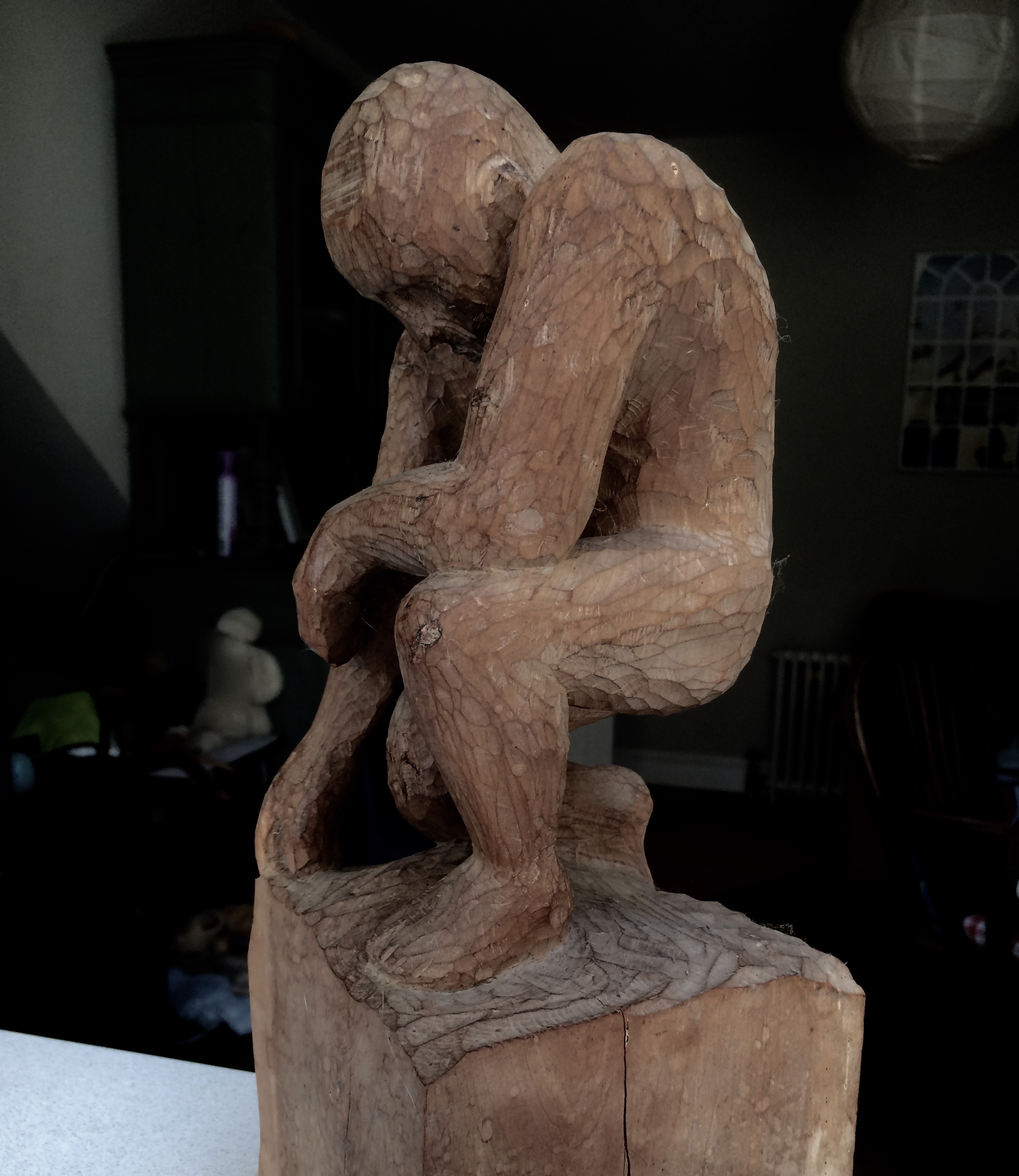
    The figure has power, but is only aware of his vulnerability & shame.

    I know I have to hide my shame above everything. I also decide that I will not report this to my House Master. I will tell no one. I learned years before that you never squeal on your peers. The potential reprisals are just too big to contemplate, and I want to show them my courage, that I can stand up to them on my own.

    The next morning I will get up as usual and carry on as if nothing has happened. I will not even show a sign of resentment, let alone victimised hurt. I will hold my head high and carry my pain so deep inside that this incident will be forgotten within a week and purged from my memory within a month.

    How wrong I am about this!

    Looking back I won’t remember any detail of sleepless nights or nightmares following the attack. I won’t have clear recall of what inner pains I went through. But I will remember continuing as usual the next day and for the rest of that term; and I will find, much to my surprise, that a boil has been burst, the oppressors have taken their pound of flesh, I am seen to have been punished whether I show remorse or not. In the aftermath, I believe I gain their respect for being able to carry on without attempting to report them, without wanting an eye-for-an -eye or a tooth-for-a-tooth, or without breaking down in any outward way.

    I have a renewed yet subtle sense that a benign force greater than I can imagine is lifting me up; has always been there, even in the darkest of times. He or She cannot protect me from experiencing life, but if I could only trust the faith, I will know deep in my heart that I am being held in a loving way, by something universal and ultimately beyond normal comprehension. It is not specifically a Christ figure or a Being of any kind, I will struggle to name it God, but the subtle energy is real, when I look for support and tune into it.

    I have no intention of giving up my links with the Stage Staff and come the following year, as rehearsals for the opera require the leading ladies to arrive on our stage several evenings a week, I will find myself attracting the attention of my first love in the form of Marian, who saves my life, confirms my heterosexuality (though we never actually lose our virginity together), and will provide me with a hugely healing distraction from my past struggles.

    In those last two years of school, I and my classmates will grow into a new level of maturity, creating fresh and positive relationships together, with mutual respect born of the stresses of ‘A’-level studies and the pressures of the much-anticipated university applications, on which our futures will depend. I say ‘we’, but I alone among my peers apply for a place at Art School, attend an interview and am accepted on the basis of my portfolio with the condition of only modest A Level results. This gives me yet another privilege as the stress of revision and exam-sitting begin to loom. Everyone else is having to buckle down to make their A and B passes, while I can relax and enjoy the best of the A level english and history classes with teachers I like, and with plenty of hours free in the Art Department.

    Only much later will I fully acknowledge the trauma of boarding school. Much later will I learn to see how over-forgiving I am by nature, preferring the passive route to any form of outrage that would honour violations of my boundaries and change a lifelong tendency to let others take advantage of me.

    The sun shines and as we move into summer and our final months together at school, I can feel the warm healing strokes of creativity and freedom, that are the hallmarks of Art school life, reaching out to me with the 4 years to come. No rush to throw off the heavy brown school uniform, or to don the colourful t-shirts and loons which become the emblems of my coming-of-age time, 1969 – 1973; with Flower Power, the Beatles, The Rolling Stones, Bob Dylan. Though actually my more gentle music of taste will be Joni Mitchell, Donovan, the Beach Boys and Crosby Stills Nash & Young.

    In these days and in these ways, I will leave the dark days of school behind, with happy memories of the Sixth Form, of just a few friends from that time, of a first love, of starting to address the complex questions of what it means to be a man in the atomic age, the arrival of feminism, freed from the rules of a dying victorian worldview, with everything new and fresh to look forward to.

    I have learned to detest hypocrisy and yet I will carry the hidden chains of Patriarchy deep inside my system for the rest of my life. The lack of confidence and self-belief that these early influences engender in me will continue to undermine my creativity, my sovereignty and my natural mysticism for many decades to come. I will continue to hide my sensitivity and fear behind a mask learned at school. At age 39, in a psychological training designed to explore and heal personal wounds, I discover two particularly significant facts about myself that will unfold later:

    There is a character in me, who is obsessed with hiding and with safety, who lives by the motto: “I would rather be a blank page than be read and misunderstood!”

    There is another character in me who feels deep empathy with women who have suffered sexually at the hands of masculine abuse, and who also attracts vulnerable women to me, such that they are able to confide in me as a gentle safe man, in order that they can face their demons and learn to trust men again.

    I will continue to distrust men through my adult life and only gradually, in the controlled environments of Men’s Groups and Men’s Rights of Passage, do I address my wounded relationship with men directly.

    This two-part article is one of a number of ways that I am trying to find peace. I have undergone many years of therapy and psychological trainings without getting to the root of my neuroses. Spiritual practice has been a huge support, and I will write about this in other articles, but as yet I am still dominated by the experience of a ‘suffering’ ego. By writing this account of school life, and expressing it in the present tense as a way of reliving the painful experiences of fifty years ago, I hope to finally loosen the grip of the wounds to my emotional self, of my distorted behaviours and of the limitations to my confidence as a man and a healthy human being..

    The material is very personal and intimate, but I have decided to defy my tendency to hide and risk exposing my truth regardless of any consequences. This feels very timely when so many women have been bravely speaking out about sexual abuses they have suffered. The effect is a social movement and cultural shift which is exposing the climate of patriarchal power that has allowed men for far too long to normalise what is totally unacceptable behaviour.

    To close I want to note that we all have an inner rapist, but unless we are prepared to own and make conscious the instincts and emotions surrounding this, we are all at the mercy of the destructive effects of acting out or projecting onto others. Truth telling and awareness-raising are the key to a healthier life, for each of us individually and for society as whole.

  • Sexual Abuse & Trauma relived – the first of a two-part account

    I am settling down in bed, adjusting to the dark, relaxing after my day, and dropping into the beginnings of sleep. Suddenly I hear movement around me as 6 or 8 male figures loom over me, surrounding my bed. I don’t immediately sense danger and It takes me a moment to realise the aggressive energy of intent that is pouring from them. Hot panic floods my body as my protective bedcovers are stripped away and a dozen silent hands lift my pyjama’d body roughly into the air, maybe one at each arm and leg and one each side at my middle. I am frozen with momentary shock and then raw adrenaline triggers my struggle to free my limbs from their grip. I swear at them to leave me alone. They respond with more force, tearing my pyjama bottoms down to expose my privates. Although there are no lights on, they can see my body from a light outside the un-curtained windows. I only see shadowed faces, but I know who they are.

    And then one of them, the leader I guess, starts to handle my private parts pulling on my penis, taunting me with how limp it is, and then pumping it with his fingers as if trying to induce an erection. I will forget his words, although the experience I will never forget. He implies that if I am gay I should be enjoying this. At these words one of the others makes a symbolic gesture of pushing his finger between my buttocks and pressing up my ass. There is no penetration and yet I feel defiled in that moment of absolute victimisation.

    All this probably lasts only a few seconds, but time is standing still for me as I am gripped in a maelstrom of terror and outrage, humiliation and shame – oppressed by the oppressors. Then I feel my body slump back down on the bed and they are gone, away into the shadows. I lie there unmoving and disassociated for several minutes, as my inner heat is cooled by the night air on my stripped naked body. I pull my pyjamas back over me as if to cover my shame in the dark. I feel broken and beaten by the sense of violation and victimisation at the hands of such distorted masculine domination. The visceral sense of being punished for being too sensitive, too artistic, too feminine, is all part of my confusion and pain. I am aware of something deeply life-changing having taken place. But I already start to minimise it out of a desperate need to feel normal again.

    It will take me many years to fully comprehend the extent of this abuse and to honour myself as a sensitive man instead of trying to hide it. It will take me many years before I can share such a traumatic event with a few close friends, and finally to be able to name it as a rape experience, penetration or not.

      I am 16, I am a sensitive adolescent preparing for my ‘O’ level exams in a class of youths who have been making it very clear that they do not like my behaviour and my attitude towards them. The dominant gang among them has decided to punish me, calling me a queer and a puff. I have been attending classes in the face of this oppressive atmosphere for weeks on end. I feel the pain inside and try to hold my head high on the outside. I am used to living this way, refusing to show they can hurt me, but lately they have been expressing their anger and frustration, by calling me self-righteous and cocky. They cannot tolerate difference, sensitivity.

    Bullying, which has always been rife, is the accepted way of expressing this intolerance and is of course, as I learn much later, driven by the projected pain, fear and vulnerability that everyone suffers in this all-male english boarding school. And so it has always been.

    I can only see my side of the situation, after 3 years of living through a particularly invasive and painful kind of verbal abuse. But, this term, I have found an unexpected solution, a partial escape. I will explain: I am not the only artistically inclined student in my year; there are several musicians. But as the sole visual artist, my talent has been acknowledged such that I have been invited to join the ‘stage staff’, as we are known; a team of boys who manage the school’s stage productions: the scenery for plays, the lighting and all the essential processes that go on behind the scenes in the school’s theatre productions. I have been put in charge of designing and painting the sets for the opera Cosi Fan Tutte.

    As a member of the Stage Staff we are allowed to work and hang out in the backstage areas at any time out of school teaching hours. I initially looked up to the other members, who are mainly sixth formers, older and well versed in all the operations of the stage. To my great relief and joy, they have accepted me for who I am as a person, instead of the female sexual object which had become my cross to bear since my first year. Now I have found myself among a more mature group who have accepted me without prejudice and I have quickly gained respect for my contributions, artistically and socially.

    This has been my lucky escape from the tyranny of fifth form life, but also the source of the bullying that’s been building up in the face of my move. My classmates have clearly been angered by my new allegiances, by my disappearances, and the privileges we stage-staffers enjoy.

    In a way they are right to be envious. All of us fifth formers expend hours of time and energy looking for ways to escape the boring routines of school life, the rules and restrictions that frustrate our need to rebel and experiment with life. Many of us smoke behind the bike sheds, funk gym classes and defy the curfew on dark evenings to turn up at the back door of a local pub for illicit bottles of cheap beer. There is an underbelly of rebellious competition that drives us to break rules and get away with all sorts of out-of-bounds activities. Like most teenagers, we need to take risks and pump adrenalin. There are a few leaders and always enough followers willing to join forces, creating a sense of safety in numbers.

    And then suddenly I have been enjoying legitimate freedoms unavailable to the rest of my class. Hence an added source of the anger and rejection displayed by my peers. I was able to live with this ostracisation for a while with the hope they would become bored and turn their focus onto someone else, but I was totally unaware of the lengths they would be willing to go to ensure that I am harshly and painfully punished for what I represent to them. I can’t tell if they genuinely believe I am homosexual; after all, in the eyes of these jocks, anyone who is interested in the dramatic arts has to be a queer. Such is the narrow and prejudicial climate I am living in.

    But these days I am experiencing a depth of companionship and camaraderie with my friends behind the stage, that I have not known before. I had been spending less and less time with the fifth form gang to minimise negative attention, in whose presence I have to grit my teeth, as I am now so used to doing. My defences against verbal abuse are strong but this latest event is of a different caliber.

    To be continued…….