A new poem by Ardhan (Paul) Swatridge – October 2019
We learned so much:
How not to trust,
how not to feel
and if we did,
to hide our fear
our loneliness,
our inner truth,
at any cost.
The rules served to
indoctrinate,
forced compliance,
closed our hearts.
We all obeyed
except the few
who broke and went
to darker hells.
We who survived,
the lucky ones,
buried deep our pain,
which sits for years,
a weight in waiting
for that later crisis
or the drip drip drip
that wears away the stone.
We needed armour then,
to try to be a ‘man’,
though much too young,
our innocence suppressed:
that vulnerable beauty
of shame-free feelings
lived fully in the raw;
of laughter, tears and rage.
Creativity first flowed
and then was blindly crushed
beneath those adaptations;
‘for your own good’ – they said.
So I forgot to mind
that innocent one,
to hug and hold that boy;
his fragile truth betrayed.
Is this present crisis
now another chance
to override my need
for a grey numb state?
for safe isolation,
for letting go a lie?
Can those hatches,
battened down for decades,
release their padlocks now?
Can I dare to feel
the grief of those lost years?
Can I let my ‘pleaser’ go?
Can I face the facts
and name it trauma now?
Can I give myself
the gift ‘he’ holds
in ‘his’ unblemished hands?
Relief at last, to breathe him
back to life again.
A light to penetrate
the dark of old beliefs
that nothing ever tried
could mend those cracks.
Now hope and love
are seeping through.
Is this coming home
after so long away?
Can these fragments
make a healthy whole?
So many loves lost,
but what about him?
He awaits me still,
to hold him and say,
“I love you my son.”
Boarding school, a peculiarly British form of abuse, has devastating impacts not only on the boarders, but on those they grow up to dominate.
By George Monbiot, published in the Guardian 7th November 2019
There are two stark facts about British politics. The first is that they are controlled, to a degree unparalleled in any other Western European nation, by a tiny, unrepresentative elite. Like almost every aspect of public life here, government is dominated by people educated first at private schools, then at either Oxford or Cambridge.
The second is that many of these people possess a disastrous set of traits: dishonesty, class loyalty and an absence of principle. The current Prime Minister exemplifies them. What drives him? What enables such people to dominate us? We urgently need to understand a system that has poisoned the life of this nation for over a century.
I think I understand it better than most, because there is a strong similarity between what might have been the defining event of Boris Johnson’s childhood and mine. Both of us endured a peculiarly British form of abuse, that is intimately associated with the nature of power in this country. We were sent to boarding school when we were very young.
He was slightly older than me (11, rather than 8), but was dispatched, as so many boys were, after a major family trauma. I didn’t think a school could be worse than my first boarding school, Elstree, but the accounts that have emerged from his – Ashdown House – during the current independent inquiry into child sexual abuse, suggest that it achieved this improbable feat. Throughout the period when Johnson was a pupil, the inquiry heard, paedophilia was normalised. As the journalist Alex Renton, another ex-pupil, records, the headmaster was a vicious sadist, who delighted in beating as many boys as possible, and victimised those who sought to report sexual attacks and other forms of abuse.
Johnson was at first extremely hostile to the inquiry, describing it as money “spaffed up a wall”. But he later apologised to other former pupils. He has accepted that sexual assaults took place at the school, though he says he did not witness them. But a culture of abuse affects everybody, one way or another. In my 30s, I met the man who had been the worst bully at my first boarding school. He was candid and apologetic. He explained that he had been sexually abused by teachers and senior boys, acting in concert. Tormenting younger pupils was his way of reasserting power.
The psychotherapist Joy Schaverien lists a set of symptoms that she calls Boarding School Syndrome. The effects of early boarding, she finds, are similar to being taken into care, but with the added twist that your parents demand it. Premature separation from your family “can cause profound developmental damage”.
The justification for early boarding is based on a massive but common misconception. Because physical hardship in childhood makes you physically tough, the founders of the system believed that emotional hardship must make you emotionally tough. It does the opposite. It causes psychological damage that only years of love and therapy can later repair. But if there are two things that being sent to boarding school teach you, they are that love cannot be trusted, and that you should never admit to needing help.
On my first night at boarding school, I felt entirely alone. I was shocked, frightened and intensely homesick, but I soon discovered that expressing these emotions, instead of bringing help and consolation, attracted a gloating, predatory fascination.
The older boys, being vulnerable themselves, knew exactly where to find your weaknesses. There was one night of grace, and thereafter the bullying was relentless, by day and night. It was devastating. There was no pastoral care at all. The staff watched with indifference as the lives of the small children entrusted to them fell apart. They believed we should sink or swim. (The same philosophy applied to swimming, by the way: non-swimmers were thrown into the deep end of an unheated pool in March).
I was cut off from everything I knew and loved. Most importantly, I cut myself off from my feelings. When expressions of emotion are dangerous, and when you are constantly told by parents and teachers that this terrible thing is being done for your own good, you quickly learn to hide your true feelings, even from yourself. In other words, you learn the deepest form of dishonesty. This duplicity becomes a habit of mind: if every day you lie to yourself, lying to other people becomes second nature.
You develop a shell, a character whose principal purpose is to project an appearance of confidence and strength, while inside is all fear and flight and anger. The shell might take the form of steely reserve, expansive charm, bumbling eccentricity, or a combination of all three. But underneath it, you are desperately seeking assurance. The easiest means of achieving it is to imagine that you can dominate your feelings by dominating other people. Repressed people oppress people.
In adulthood you are faced with a stark choice: to remain the person this system sought to create, justifying and reproducing its cruelties, or to spend much of your life painfully unlearning what it taught you, and learning to be honest again: to experience your own emotions without denial, to rediscover love and trust. In other words, you must either question almost nothing, or question almost everything.
Though only small numbers of people went through this system, it afflicts the entire nation. Many powerful politicians are drawn from this damaged caste: David Cameron, for example, was seven when he was sent to boarding school. We will not build a kinder, more inclusive country until we understand its peculiar cruelties.
It might have just been one of a number of ways that staff imposed their authority over school mealtimes, but I remember the day that the spotlight was on me in the most excruciating way. In the middle of a typical noisy lunch, with staff members eating at their table raised on a dais at one end of the dining hall, a loud bell sounded and we all reluctantly but dutifully fell into silence.
From her seat next to her husband, the headmaster’s wife called my name, following it with a rhetorical question, designed to shame: “Swatridge!” – all eyes turn to me in the pregnant silence – “Why are you holding your spoon in your left hand? You know you should be using your right hand to eat with.”
I remember the initial feeling of panic in that moment. I probably did swap hands just to take the accusing attention away from myself and so everyone could return to their meal. But underneath my embarrassment was something much more authentic. A sense of defiance coming from deep within me, along with an inner voice for which my ten-year-old self may not have had words. But I can express this now as:
“You can control me and command my compliance in so many ways, but my left-handedness is an intrinsic part of who I am and you are NOT going to take that away from me!”
I can feel the anger rising in me now, at the injustice of what happened all those years ago. But the fact that it has stayed with me as a significant or even typical and potentially harmful influence on my character, is a useful reminder to stand up and be proud of who I am, rather than hide, the learned pattern that I needed for self-protection, and which became my strategy for survival.
This was just one of many traumatic moments at boarding school. Traumatic because of the low level of fear that I lived with all the time with no-one to go to for support or advice, as well as the specific moments, like standing outside the headmaster’s office, waiting to be beaten with the cane or the slipper. The waiting being intentional, to prolong the psychological aspects of our punishment.
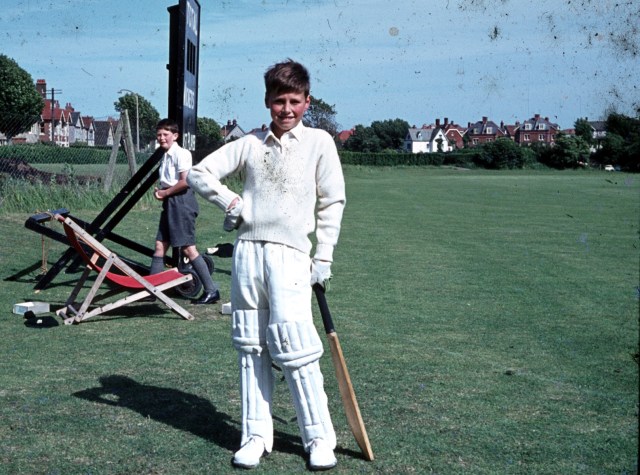
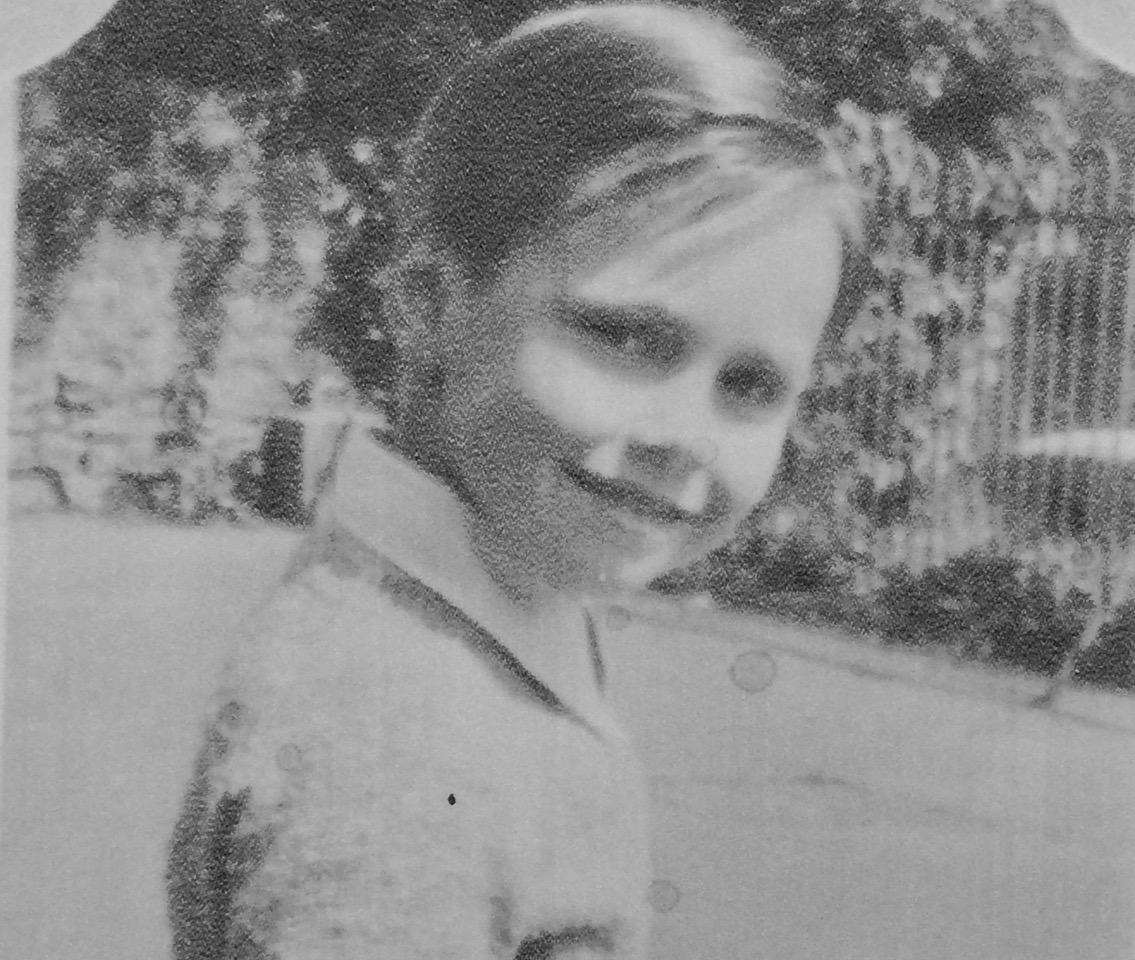
me, captain of cricket age 11.
Of course, there were many aspects of those school years that were moments of triumph and pride in achievement; that were character-building, that were full of fun and pleasure. We learned to focus on the positives to get through our challenges, and it is only years later, in a conscious revisiting of the experiences, that the darker side of those years gradually connects me more and more with the emotional scars that have influenced my adult life in negative ways.
It is years later, through engaging with these processes that those old defence mechanisms and shame-based limitations can dissolve and fall away, to leave me naked in the authenticity and truth of who I can be.
It is a journey, long and winding, perhaps with no final destination; but no-one else can walk it for us, and we owe it to ourselves in our search for our unique right to be, for self-belief and for an elusive inner peace.
It has taken me fifty years to reach a point in my life where I feel ready to talk openly about some of my teenage boarding school experiences. Since my late thirties I have tried to address the most painful aspects of those years, seeking therapeutic approaches whenever my life’s challenges seemed to point to my early wounds as their source. But out of denial and a habitual stiff-upper-lip,I have kept my story close to my chest. The psychotherapeutic help I have received has been only partially successful.
I have recently lowered my armour enough to accept the levels of trauma and shame that I have been carrying from those school years, because whenever I have found myself paralysed with fear and unable to speak out, I failed to see the extent to which my ‘weakness’ as a man, as I saw it, led straight back to the terror of the small boy from my childhood. I have been hard on myself all this time and minimised in my mind, the effect of those school years, through the numbing and dis-association that my system employed to get me through that time, and which became my unconscious response for creating safety when under pressure or threat in my adult life.
It was skilful means for a small boy, but life limiting for the man ever since.
I hope by revealing what I have kept hidden from all but my closest partners along the way till now, my account will serve to lighten the load for other men and women who have struggled through their lives with a heavy weight on their shoulders. I do not claim that the challenges I lived through during my school years were worse than those of any others who became victims of abuse, whether mental, emotional or physical. There are thousands of people out there who are carrying burdens much bigger and more damaging than mine. But I offer my story in service to those people, in all walks of life, who are longing to find ways to heal old wounds and make peace with themselves.
The way it happened to me was like the drip-drip-drip of water on stone:
I arrived at my secondary boarding school, on the strength of my Common Entrance exam, age thirteen. We were based in a Victorian brick mansion nestling in a large area of woodland a mile and a half away from the main school. At thirteen we were there for just one year before moving permanently up to the main school, although in that first year most of our lessons and other activities involved walking through the woods each morning, and into the village, to reach the school for our daytime studies.
For the first two months, September and October, we could make the journey back to our night-time base in broad daylight, having our evening meal there and our period of prep before bed. But as the nights drew in, the walk back through the woods in twilight conditions and then in complete darkness, was at best an eerie experience. I remember becoming terrified of this nightly ordeal. I think I had always had a childhood fear of the dark and of dark woods particularly, but I had specific reasons for this being heightened for me, as the days and months passed.
I had not been at this school long when I became aware of older boys taking an interest in me. These boys were attracted to my soft girl-like features and, being an all-boys school, there were one or two poor souls each year who were picked out as the ‘pretty boys’ to become the focus of all the pubescent testosterone and unexpressed sexual energy raging through the school, which was of course a virtual prison.
This sexual energy had nowhere to go except towards those of us who were forced to become surrogate females, in service to the relief of that pressure valve in the system. The sexual aspect of this was the dominant factor, for in fact we were known as ‘bum boys’ (a name that still triggers me); but I can see now, that having been separated from our mothers, many of us since the age of eight when we were packed off to our first boarding school, we craved contact with any female energy, and more sinisterly for us ‘pretty boys’, we faced the disowned anger of sons abandoned by their mothers. I can now see how this explains the edginess of the attention I drew towards myself; all that anger wrapped up in the abusive tone of the words used towards and against me, that I had to learn to face and endure on a daily basis, as the designated ‘female’ in our year.
I found it scary to be noticed by older boys, especially fifth and sixth formers, who seemed like grown men to me. Taunting comments came more regularly from the year above me and gradually, as ‘gorgeous’ became my nickname (virtually everyone had a nickname of some kind), boys in my own year joined in and tended to treat me the same way. I quickly learned not to react, trying to deflect all forms of attention, whether abusive jibes, or more appreciative and harmless ones. Soon it all became a relentless daily nightmare for me, continuing for the next three years, during which time all teachers and staff seemed completely blind to or oblivious of my predicament. I never once tried to seek help from my so-called guardians after two experiences where teachers witnessed sexualised comments towards me and just sniggered knowingly, rather than making some effort to stop what was happening.
I felt like I was seen only as an objectified female; there for everyone’s pleasure; there to allow a release of everyone’s frustrated sexuality, sexual confusion, along with all the new-found feelings of adolescence that needed to be explored, including their repressed anger towards their mothers; none of which had a legitimate outlet for expression.
Usually I could tell if boys were just using me to let off steam with no personal attachment to me or to an outcome; for whom this was just a phase they would work through and then move on into a more mature heterosexuality. But I became aware that there were a few boys who showed an interest in me that was more personal and targeted. This could be out of their own neediness, or because they had already secretly identified their permanent homosexual orientation.
My first experience of this was in my first year when Jones, a boy one year older than me, accosted me in the school grounds, making it clear he liked me and inviting me into the woods with him. He was mildly intimidating, and I was scared, although my memory has become vague about the details. I seem to remember he wrestled me to the ground and started to fondle me, but I must have managed to stop him going further and I got away. He never tried this again, though it was months before my fear of him relaxed, realising Jones had lost interest and moved on.
For the next four years I held resentment towards him for what he had tried to do, and it showed me how I needed to guard against putting myself at risk in this way. I never knew if Jones was genuinely feeling a sexual attraction to me or whether he was just trying to overcome his own sense of vulnerability by showing off his power and ingratiating himself with his friends, because he had started his ‘hit’ on me in a very public way. A lot of that went on.
So that painful encounter with Jones, age thirteen, and other particularly personal and threatening verbal exchanges, put me in a constant state of alert for my safety and wellbeing. In my first year, those nightly walks back through the woods, with a minimum of electric lighting to show the way along the path, became an ordeal for me. If I was with class mates I felt safe, so I tried to engineer this each day. But there were evenings, when I had been doing some extra activity, I had to return later than the main body of boys, and so faced the prospect of making the journey alone. I was always terrified that an older boy would follow me, or would be hiding in the bushes, waiting to grab me when I came past.
Thankfully, nothing serious did happen, but I was never free of the threat of it in my mind. I was being accosted with verbal reminders of who or rather ‘what’ I was in the eyes of the school, many times each day, so I was never allowed to forget I was the fancied ‘gorgeous’ object of attention.
It was a traumatising time for me, something I have only recently come to accept fully, as I have looked deeply into the damaging effects on my adult life. There was worse to come but first I need to add that there was another side to this coin and other aspects of my circumstances that complicated my overall experience of boarding school. I had already been boarding for five years at my prep school. I had already established that I told my parents virtually nothing of my troubles, only the positives. I was often lonely, I was isolated and I was seriously lacking affection and physical contact. This was the cruel nature of boarding school.
So given all this, there was an aspect of the attention I was getting which affirmed that I was an attractive person. It was feeding a need in me to be seen, appreciated and liked. A natural and necessary need in all young people. So perversely, I often enjoyed the attention I got; and yet, as with all victims of harassment or abuse, I could not risk showing that I enjoyed it. It was a painful double bind, which only led me to feel more lonely and isolated, trapped by my own fear of what might happen if I encouraged it.
My fear of being ‘hit on’ homosexually was a drip-feed of torture. In the face of this I returned to the saying that I had adopted earlier as my mantra:
“Sticks and stones may break my bones, but words alone can’t hurt me.”
This helped to numb the pain, while giving me a childish sense of victory over my situation and over the boys who taunted me. If I avoided physical violence I could appear indifferent. I was able to never show they could get to me, that they couldn’t hurt me with their nicknames and sexualised comments. I must have held fury deep inside that I also withheld from my perpetrators and in the end I paid a big price for my determination to rise above their games. Through my reactions, or lack of them, I was becoming trapped by my own stubbornness and self-righteous pride so that eventually they wanted their revenge. I will come to that.
The fact is that while my tactics allowed me to look strong and resilient on the outside, I was hurting and often screaming on the inside; living in a state of alertness and fear for my physical and psychological safety. It left me with exhausted adrenal glands which has affected my health in later life. It must have taken its toll on me even then. I found myself slipping behind some of the brighter kids with our academic work, although I did sit and pass 10 ‘0’ levels age sixteen, so in spite of my situation, I not only managed to keep my troubles from my parents, I was able to impress them with my achievements and do justice to the ‘privileged’ education they were affording me. Ironic as it may seem, I was still stuck in the naive belief, that if I didn’t achieve and do well, my parents wouldn’t love me.
If you, the reader are thinking at this point, “why the hell didn’t you tell your parents and ask to leave? After all you sound way too sensitive a child to be placed in a boarding school environment for ten years.” You would be right, But the fact is it never once occurred to me that I could get help to escape or change my situation. We children didn’t have a sense of our needs and rights in the way that most young people have today.
Even now I recognise a childlike belief that sits deep in my system and has played out in my life over and over again in negative ways. The belief that I am stuck in the grip of the situation I find myself in, with no right or ability to question or challenge it, however difficult, painful or destructive it is for me. I feel powerless to do anything about it. There seems no point in speaking out or sharing my problems. I just have to silently accept my situation and get on with it, alone, adapting myself around other people, letting them have their way, with no sense of my own power. This belief has kept me tied to people in unhealthy relationships and in one instance, it took a psychotherapist to shock me into action by saying to me: ‘you have to get out of this relationship or you will die!’ It is not difficult to see where this stubborn belief originated, a victim identity that as a mature man, has been a major source of shame.
My saving grace at school perhaps, was that I showed myself to be a skilled and plucky player on the sports field. In fact my forte was squash and I played for the school at various levels for this as well as for hockey, cricket and tennis, gaining genuine respect and kudos with parents, teachers and the boys around me. In this forum at least, I could prove myself to be a man.
By the time I got to the fifth form, I realised I was literally the only boy in my year who had an interest in art. This set me apart in yet another way, which was both good and bad. I found peace and solace in the art room, away from the rough and tumble of my peers. I even expressed some of my angst in my paintings and sculptures. I had sensibilities and feminine qualities, which I rarely felt safe enough to express, but here was one of the few places where I had an outlet during those years. It felt wonderful to have my art teacher quietly supporting and affirming my sensitivity and creativity.
I was invited to get involved with painting scenery for a theatre production, and through this opportunity I discovered a further escape from my lot in mainstream school. I began to spend all my free time behind the stage, and was enrolled as one of the ‘stage staff’. I made new friends there, people who seemed to accept and respect me as a human being instead of seeing me as a sexual object. This was refreshing, comforting and very healing. I was able to start showing myself more, expressing my feelings. I could breathe and share creative time with these people.
My class mates on the other hand took great exception to my involvement with the stage. In their eyes (probably their parents’ eyes actually) all actors and anyone connected with the theatre were ‘queers and poofs’. In their eyes I had become one of ‘them’ and this confirmed that I was and always had been a faggot, a level up (or down) from just being a ‘pretty boy’. I had by then matured too, my voice had fully broken, and although I still looked young and fresh-faced, other younger boys had arrived at the school to take over from my given role, and become the next generation of ‘bum boys’.
The upshot of this new dynamic between me, as a member of the stage staff, and the rest of my year, was a vicious period of taunting and bullying. They seemed to resent my success in finding ways to live outside of their control, sidestepping the feminine role they were used to me playing for them. I was feeling safer and strong enough to rebuff their taunts. This only made them more angry and, unbeknown to me, they began to plot a way to teach me a lesson.
Continued in my post: Sexual Abuse and Trauma Relived – parts one and two.
My defences against verbal abuse are strong; walled-off and defended after years of boarding school life, away from the relative safety and protection of family and home. I am numbed, emotionally starved, often lonely and miserable, having been relentlessly taunted and harassed in a sexual way that has reduced me inwardly to a confused, fearful victim, in spite of my personal motto: “Sticks and stones may break my bones, but words alone can’t hurt me.”
Somehow my 5th Form peers know that now. They planned a different kind of lesson for my impregnable defences. They conceived a humiliation to break through all my psychological defences to expose the softest, most precious and purest part of me; under the nose of authority, but hidden from its judicial and often conveniently averted eyes. The weeks of ongoing threat became a kind of personal torture.
So this is how the attack came about. The assault – the rape. I now realise that my lingering terror is not so much about what has actually happened, as about the imposition of power and control over me, my helplessness, my anticipatory fear of what they might next do to me; all in the macabre silence of the dormitory that had, till that moment, given me some sense of nightly security and escape from the clamour of school life with the daily abuse that infected me. Now I am not even feeling safe at night.
I have learned that it is so often the case that rape is carried out by people close to us and who know us. The very people we might expect and need to trust.
I sleep very little that night, shivering for hours with fear and after-shocks; hating these boys who lie in their beds around me. Yet I stay silent. Silent in my bed in stubborn refusal to let ‘them’ have the satisfaction of evidencing my pain, of sealing their victory. My old motto now becomes redundant, as I determine to prove to them that even sticks and stones can’t hurt me.
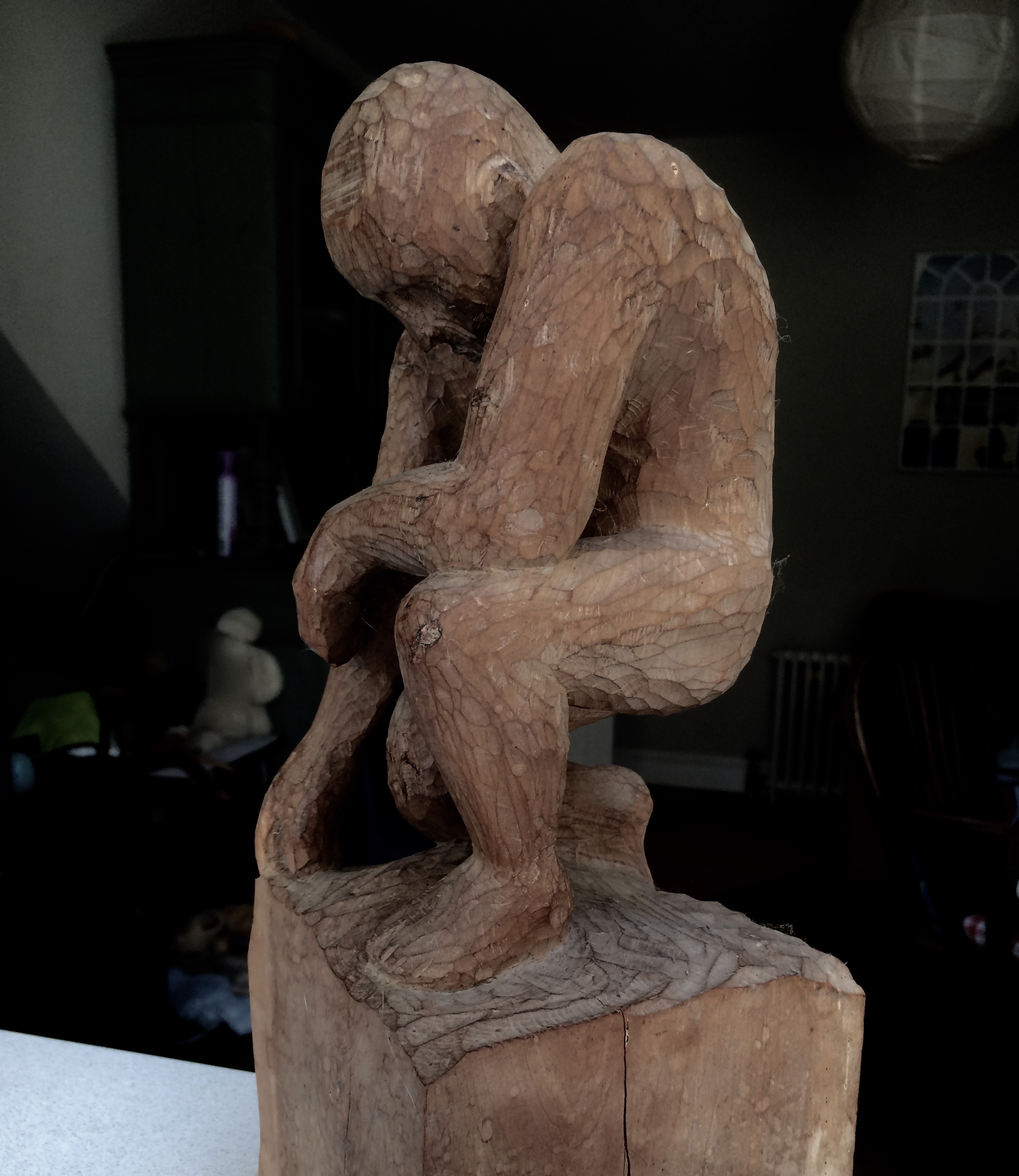
The figure has power, but is only aware of his vulnerability & shame.
I know I have to hide my shame above everything. I also decide that I will not report this to my House Master. I will tell no one. I learned years before that you never squeal on your peers. The potential reprisals are just too big to contemplate, and I want to show them my courage, that I can stand up to them on my own.
The next morning I will get up as usual and carry on as if nothing has happened. I will not even show a sign of resentment, let alone victimised hurt. I will hold my head high and carry my pain so deep inside that this incident will be forgotten within a week and purged from my memory within a month.
How wrong I am about this!
Looking back I won’t remember any detail of sleepless nights or nightmares following the attack. I won’t have clear recall of what inner pains I went through. But I will remember continuing as usual the next day and for the rest of that term; and I will find, much to my surprise, that a boil has been burst, the oppressors have taken their pound of flesh, I am seen to have been punished whether I show remorse or not. In the aftermath, I believe I gain their respect for being able to carry on without attempting to report them, without wanting an eye-for-an -eye or a tooth-for-a-tooth, or without breaking down in any outward way.
I have a renewed yet subtle sense that a benign force greater than I can imagine is lifting me up; has always been there, even in the darkest of times. He or She cannot protect me from experiencing life, but if I could only trust the faith, I will know deep in my heart that I am being held in a loving way, by something universal and ultimately beyond normal comprehension. It is not specifically a Christ figure or a Being of any kind, I will struggle to name it God, but the subtle energy is real, when I look for support and tune into it.
I have no intention of giving up my links with the Stage Staff and come the following year, as rehearsals for the opera require the leading ladies to arrive on our stage several evenings a week, I will find myself attracting the attention of my first love in the form of Marian, who saves my life, confirms my heterosexuality (though we never actually lose our virginity together), and will provide me with a hugely healing distraction from my past struggles.
In those last two years of school, I and my classmates will grow into a new level of maturity, creating fresh and positive relationships together, with mutual respect born of the stresses of ‘A’-level studies and the pressures of the much-anticipated university applications, on which our futures will depend. I say ‘we’, but I alone among my peers apply for a place at Art School, attend an interview and am accepted on the basis of my portfolio with the condition of only modest A Level results. This gives me yet another privilege as the stress of revision and exam-sitting begin to loom. Everyone else is having to buckle down to make their A and B passes, while I can relax and enjoy the best of the A level english and history classes with teachers I like, and with plenty of hours free in the Art Department.
Only much later will I fully acknowledge the trauma of boarding school. Much later will I learn to see how over-forgiving I am by nature, preferring the passive route to any form of outrage that would honour violations of my boundaries and change a lifelong tendency to let others take advantage of me.
The sun shines and as we move into summer and our final months together at school, I can feel the warm healing strokes of creativity and freedom, that are the hallmarks of Art school life, reaching out to me with the 4 years to come. No rush to throw off the heavy brown school uniform, or to don the colourful t-shirts and loons which become the emblems of my coming-of-age time, 1969 – 1973; with Flower Power, the Beatles, The Rolling Stones, Bob Dylan. Though actually my more gentle music of taste will be Joni Mitchell, Donovan, the Beach Boys and Crosby Stills Nash & Young.
In these days and in these ways, I will leave the dark days of school behind, with happy memories of the Sixth Form, of just a few friends from that time, of a first love, of starting to address the complex questions of what it means to be a man in the atomic age, the arrival of feminism, freed from the rules of a dying victorian worldview, with everything new and fresh to look forward to.
I have learned to detest hypocrisy and yet I will carry the hidden chains of Patriarchy deep inside my system for the rest of my life. The lack of confidence and self-belief that these early influences engender in me will continue to undermine my creativity, my sovereignty and my natural mysticism for many decades to come. I will continue to hide my sensitivity and fear behind a mask learned at school. At age 39, in a psychological training designed to explore and heal personal wounds, I discover two particularly significant facts about myself that will unfold later:
There is a character in me, who is obsessed with hiding and with safety, who lives by the motto: “I would rather be a blank page than be read and misunderstood!”
There is another character in me who feels deep empathy with women who have suffered sexually at the hands of masculine abuse, and who also attracts vulnerable women to me, such that they are able to confide in me as a gentle safe man, in order that they can face their demons and learn to trust men again.
I will continue to distrust men through my adult life and only gradually, in the controlled environments of Men’s Groups and Men’s Rights of Passage, do I address my wounded relationship with men directly.
This two-part article is one of a number of ways that I am trying to find peace. I have undergone many years of therapy and psychological trainings without getting to the root of my neuroses. Spiritual practice has been a huge support, and I will write about this in other articles, but as yet I am still dominated by the experience of a ‘suffering’ ego. By writing this account of school life, and expressing it in the present tense as a way of reliving the painful experiences of fifty years ago, I hope to finally loosen the grip of the wounds to my emotional self, of my distorted behaviours and of the limitations to my confidence as a man and a healthy human being..
The material is very personal and intimate, but I have decided to defy my tendency to hide and risk exposing my truth regardless of any consequences. This feels very timely when so many women have been bravely speaking out about sexual abuses they have suffered. The effect is a social movement and cultural shift which is exposing the climate of patriarchal power that has allowed men for far too long to normalise what is totally unacceptable behaviour.
To close I want to note that we all have an inner rapist, but unless we are prepared to own and make conscious the instincts and emotions surrounding this, we are all at the mercy of the destructive effects of acting out or projecting onto others. Truth telling and awareness-raising are the key to a healthier life, for each of us individually and for society as whole.
I am settling down in bed, adjusting to the dark, relaxing after my day, and dropping into the beginnings of sleep. Suddenly I hear movement around me as 6 or 8 male figures loom over me, surrounding my bed. I don’t immediately sense danger and It takes me a moment to realise the aggressive energy of intent that is pouring from them. Hot panic floods my body as my protective bedcovers are stripped away and a dozen silent hands lift my pyjama’d body roughly into the air, maybe one at each arm and leg and one each side at my middle. I am frozen with momentary shock and then raw adrenaline triggers my struggle to free my limbs from their grip. I swear at them to leave me alone. They respond with more force, tearing my pyjama bottoms down to expose my privates. Although there are no lights on, they can see my body from a light outside the un-curtained windows. I only see shadowed faces, but I know who they are.
And then one of them, the leader I guess, starts to handle my private parts pulling on my penis, taunting me with how limp it is, and then pumping it with his fingers as if trying to induce an erection. I will forget his words, although the experience I will never forget. He implies that if I am gay I should be enjoying this. At these words one of the others makes a symbolic gesture of pushing his finger between my buttocks and pressing up my ass. There is no penetration and yet I feel defiled in that moment of absolute victimisation.
All this probably lasts only a few seconds, but time is standing still for me as I am gripped in a maelstrom of terror and outrage, humiliation and shame – oppressed by the oppressors. Then I feel my body slump back down on the bed and they are gone, away into the shadows. I lie there unmoving and disassociated for several minutes, as my inner heat is cooled by the night air on my stripped naked body. I pull my pyjamas back over me as if to cover my shame in the dark. I feel broken and beaten by the sense of violation and victimisation at the hands of such distorted masculine domination. The visceral sense of being punished for being too sensitive, too artistic, too feminine, is all part of my confusion and pain. I am aware of something deeply life-changing having taken place. But I already start to minimise it out of a desperate need to feel normal again.
It will take me many years to fully comprehend the extent of this abuse and to honour myself as a sensitive man instead of trying to hide it. It will take me many years before I can share such a traumatic event with a few close friends, and finally to be able to name it as a rape experience, penetration or not.
I am 16, I am a sensitive adolescent preparing for my ‘O’ level exams in a class of youths who have been making it very clear that they do not like my behaviour and my attitude towards them. The dominant gang among them has decided to punish me, calling me a queer and a puff. I have been attending classes in the face of this oppressive atmosphere for weeks on end. I feel the pain inside and try to hold my head high on the outside. I am used to living this way, refusing to show they can hurt me, but lately they have been expressing their anger and frustration, by calling me self-righteous and cocky. They cannot tolerate difference, sensitivity.
Bullying, which has always been rife, is the accepted way of expressing this intolerance and is of course, as I learn much later, driven by the projected pain, fear and vulnerability that everyone suffers in this all-male english boarding school. And so it has always been.
I can only see my side of the situation, after 3 years of living through a particularly invasive and painful kind of verbal abuse. But, this term, I have found an unexpected solution, a partial escape. I will explain: I am not the only artistically inclined student in my year; there are several musicians. But as the sole visual artist, my talent has been acknowledged such that I have been invited to join the ‘stage staff’, as we are known; a team of boys who manage the school’s stage productions: the scenery for plays, the lighting and all the essential processes that go on behind the scenes in the school’s theatre productions. I have been put in charge of designing and painting the sets for the opera Cosi Fan Tutte.
As a member of the Stage Staff we are allowed to work and hang out in the backstage areas at any time out of school teaching hours. I initially looked up to the other members, who are mainly sixth formers, older and well versed in all the operations of the stage. To my great relief and joy, they have accepted me for who I am as a person, instead of the female sexual object which had become my cross to bear since my first year. Now I have found myself among a more mature group who have accepted me without prejudice and I have quickly gained respect for my contributions, artistically and socially.
This has been my lucky escape from the tyranny of fifth form life, but also the source of the bullying that’s been building up in the face of my move. My classmates have clearly been angered by my new allegiances, by my disappearances, and the privileges we stage-staffers enjoy.
In a way they are right to be envious. All of us fifth formers expend hours of time and energy looking for ways to escape the boring routines of school life, the rules and restrictions that frustrate our need to rebel and experiment with life. Many of us smoke behind the bike sheds, funk gym classes and defy the curfew on dark evenings to turn up at the back door of a local pub for illicit bottles of cheap beer. There is an underbelly of rebellious competition that drives us to break rules and get away with all sorts of out-of-bounds activities. Like most teenagers, we need to take risks and pump adrenalin. There are a few leaders and always enough followers willing to join forces, creating a sense of safety in numbers.
And then suddenly I have been enjoying legitimate freedoms unavailable to the rest of my class. Hence an added source of the anger and rejection displayed by my peers. I was able to live with this ostracisation for a while with the hope they would become bored and turn their focus onto someone else, but I was totally unaware of the lengths they would be willing to go to ensure that I am harshly and painfully punished for what I represent to them. I can’t tell if they genuinely believe I am homosexual; after all, in the eyes of these jocks, anyone who is interested in the dramatic arts has to be a queer. Such is the narrow and prejudicial climate I am living in.
But these days I am experiencing a depth of companionship and camaraderie with my friends behind the stage, that I have not known before. I had been spending less and less time with the fifth form gang to minimise negative attention, in whose presence I have to grit my teeth, as I am now so used to doing. My defences against verbal abuse are strong but this latest event is of a different caliber.
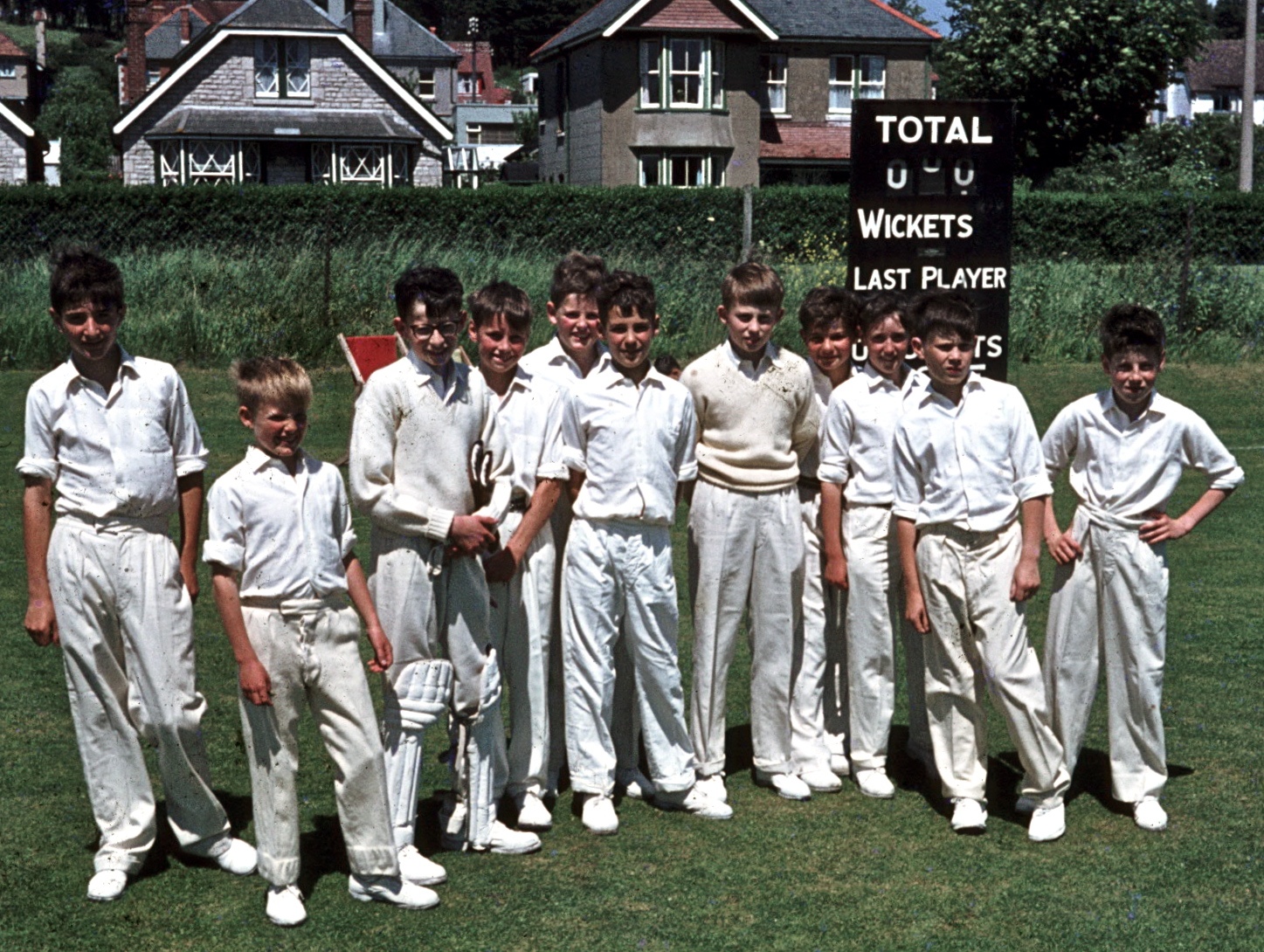
School cricket team. I am 4th from the left at the back, age 10 or 11.
I was eight when I arrived at Boarding School (see my article describing this, dated March 2015).
At some point in those early days, seeded by that first lonely night away from home, I made a massive but unconscious decision that would have far-reaching effects for the rest of my life. But first I need to describe a little more of my story and some of the psychological awareness I have subsequently been able to bring to it.
I left my family home, mother, father, sister, pet dog and two cats, plus all the animals on the small farm that was my world since the age of two. I left the fields, the trees, the hedges and ditches, the ponds and streams, the sheds and agricultural machinery, the nearby village with my primary school and the little village shop, where I spent my pocket money on sweets and lucozade. I left the friends I made at primary school and the adventure games my sister and I played on our farm in rural Dorset.
The stark reality I faced was the loss of all that. I was thrust suddenly out of the only world I knew into another alien world, where all the boys spoke with an upper class twang. I did not know it, but I arrived at the school with a west country accent. Not a strong one, I don’t remember being teased about it, but when I went home for the four days of half term after seven weeks away, my father teased me about the new ‘posh‘ accent I had acquired.
In order to fit in and feel that I belonged at school, I was unconsciously emulating the style of the other boys who were mainly sons of lawyers and other professionals or from the ruling class, with fathers overseas governing what remained of the British Empire.
I found myself stranded between two worlds. The world of my parents, was modest and narrow, yet it had afforded me security and a sense of who I was. Returning to it from this point on was never quite the same. Returning for the holidays I began to feel like a ‘visitor’ in my family home.
At school I pined for the familiarity, warmth and security I had known at home. I later found that being at home on the farm for the holidays was a wonderful release from the prison-like routines and regulations, a time to let down my guard, replenish my sensitive soul and just be me, away from the relentless proximity of male bodies and the constant striving for achievement. But from the day I left for boarding school, I never again felt fully a part of my family and I lost the spontaneous innocence and openness of my early childhood. I don’t know if this showed. In our family we were all good at keeping up appearances.
However harsh and alien my new world seemed, it was also a more privileged and monied one. I knew I had to find ways to try to belong there. It became embedded in my nature to adapt and fit in and, as if it was familiar to me from a past life, I quickly emulated the ways of these posh boys and passed myself off as one of them. But my parents weren’t of the same background as those of my new peers, and my father’s teasing joke about my acquired accent, augmented the painful feeling that I didn’t properly belong in either camp.
The money for my expensive education, by the way, came from a trust fund set up by our great aunt. It was all spent on me, because apparently my sister was doing well at the local school and was considered too shy to manage away from home, whereas I wasn’t progressing well at the village school, my teacher found me disruptive and my parents thought I would benefit from the extra discipline of a private school. They had sat me down and asked me if I wanted to go to boarding school as if I, age eight, could know what that was. I think I probably did say yes, without any idea of the implications. How could I have?
But back to my memories of those formative years and the events that so effectively set me up to create the conditions I experienced in my adult life.
The school had a cruel but effective policy for ‘breaking in’ new boys. We weren’t allowed to see our parents for the first three weeks, at the end of which we had an ‘exeat’, the name for the sundays when our parents could come and collect us and take us out for the day. That first three weeks seemed endlessly long. Some boys showed obvious signs of homesickness, and the plaintive sobs from some of the beds after lights out continued on and off during that time.
Once a week we were given writing paper and instructed to write a letter to our parents. It was carried out in the classroom with a master supervising. My only clear recollection of this was of the deputy headmaster’s wife supervising us. She was one of only four female figures in the school. the other three being Matron, her younger assistant and the wife of our latin teacher, who lived in a house in the school grounds; but she had young children and rarely came into school.
As we sat contemplating this written contact with our parents and home, we were given ideas as to what we might say about our week and then we could add our own thoughts, like asking, in my case, how George my cat was doing? When we thought we had finished we had to show it to the supervisor to be checked. If there were glaring spelling mistakes or crossings out we might be made to do it again, or advised to change something we had said. We had to learn how to address an envelope and then it was posted for us.
I imagine this thinly veiled censorship was also a way of assessing if any boys were particularly homesick or disturbed about anything. I found the whole process tedious and upsetting, realising at some level that thinking about home had the potential to bring unwanted feelings to the surface.
My mother managed to write to me regularly, trying her best to keep me connected to what was going on at home. I looked forward to those letters but they mainly contained facts, with little on an emotional level; not enough to fill the hole I felt inside. She undoubtedly had to distance herself to manage her end of our loss.
My sister wrote sometimes, which was lovely. We had bickered a lot before I went away to school but I soon began to appreciate her and value her as a sister once I was away from home. I think I was a bit jealous that she was getting all the attention and advantages of being at home (she continued her schooling in the state system). I imagined her getting all the love perhaps. But years later she told me that she too found our parents lacking in their physical expressions of love. This was quite a shock to me and shattered a projection I had been carrying for decades.
And my Dad? He wrote very occasionally. He tended to stay in the background and left most of the parenting to my mother.
The amazing thing is, that in spite of all the challenges and distress that I found myself facing at that time, I made remarkable academic progress in my first term. I had been placed, as a result of my entrance exam, ninth in the class out of twelve new boys. I faced the reality of being three places from the lowest, smallest and dimmest boy in the whole school. They made sure with their publicly displayed charts that we all knew our place!
But I must have buckled down with a determination to prove that I was better than this. They must have inspired or perhaps scared me into trying to prove them wrong. By the end of that first term I was top of the class and during the next term they moved me up a class. The teaching style and disciplined regime must have suited me in this sense.
I have little memory of those times, other than a sense of learning to respond to what was expected of me, of wanting to please everybody and prove myself to be the successful achiever that we were all being groomed to become. And most of all, I see now that I was striving with the belief that to gain the love and approval of my parents, who had abandoned me and thrown me out of the nest, I had to show myself worthy of the perceived financial and emotional sacrifice that they made to ‘allow‘ me to be at this expensive privileged private school.
In other words I must have come to believe, to my detriment, that love was entirely conditional, and so I conducted my life on the basis that if I failed at school I would be letting my parents and teachers down, I would suffer humiliating shame, further rejection by my parents and teachers, and therefore lose the (conditional) love that I could allow myself to feel. Not a recipe for childhood happiness; and this was just the first of ten years in a boarding school environment.
To be continued soon.
In the next episode: ‘Toughening us up’, the emotional effects on me, on my family and for intimate relationships in my adult life.
The master led us up the grand staircase and along a dim corridor with bare and squeaky floorboards; past the dorms of the older boys, who were still chatting noisily downstairs on that first night.
We found ourselves in an attic dormitory with its eight beds all squashed in. The master left us to get to know each other and prepare for ‘lights out’, as he called it, but boyish chatter was in short supply that first evening. I felt the strained silence of shyness and unspoken distress as we all got undressed and into bed. The master returned to check that we were all tucked in, then blurting his impersonal ‘good night’, he plunged us into darkness. As the light went out I momentarily noted that several boys had already disappeared under their coarse woollen blankets.
I lay face up adjusting my eyes to the darkness until, after barely a minute, muffled sobbing came from the bed next to me, with at least one more further away. Through my disorientation and numbness came a very clear and determined thought:
‘I must be OK because I am not crying’.
My own attempt to self-comfort – the inner voice of a sensitive eight-year-old protecting himself against the unbearable pain that lay barely hidden beneath his bravery. The only thing we had in common on that dark night was that we would not be seeing our parents for three weeks at least and our homes were unimaginably far away.
My inner protecting voice ensured I survive that night and the next five years. It dampened my sense of loss. But my statement to myself also effectively cut me off from my feelings and imprinted me with emotional blocks that have affected me over the following fifty years.
I lay awake a while longer, my loneliness and confusion becoming overlaid by the more immediate fears of what tomorrow would bring; whether I would be able to find my way back to our classroom and all the other areas of this seemingly vast and spooky old building. Eventually, exhausted by it all, I fell into a restless sleep to the eerie yet soothing sound of the night wind moaning in the casement windows.
Over the next weeks and months, I grew to cherish that time of the night before sleep; lying in the dark dormitory with just my own thoughts disturbed only by the restless breathing of the other poor sods with whom I shared my life. It became a necessary moment of coming back to my self in that quiet, after all the bustle and pressure of the day. I could allow my inner feelings a little, wonder what might be happening at home, try to make sense of it all in my childlike way and worry over whatever homework or test lay in stall for us the next day, knowing that it was all down to me. Noone else was there to share my burdens and worries. There were no reassuring arms to fold myself into and no kindly words of advice to show me the way.
……..At some point in those early days, possibly even during that first lonely night away from home, I made a massive but unconscious decision that would have far-reaching effects on the rest of my life. But I will come to that later……….
– This is the first part of a longer autobiographical essay about the moulding of young souls to become leaders of men, how it affected me and my future life. I have never spoken out about it before and my story flows in fits and starts. Much of it still lurks unformed, after years of gestating in my body. Further excerpts will follow.
 We learned so much:
 Can I dare to feel