Probably the biggest challenge and barrier for any of us to deal with in trying to pursue a spiritual practice is, in our search for some degree of inner peace and self-acceptance, we eventually realise that our restless minds endlessly generate thoughts from which it seems impossible to escape.
In the early stages of meditation, years ago, I developed the belief that, with practice, I was going to be able to still my mind, empty my thoughts and float in some beatific realm of peaceful silence, from where all my earthly problems, my existential fear and my daily anxieties would all dissolve; at least temporarily.
Predictably, as I see it now, I soon experienced a lot of frustration in my meditation sessions. Unable to distance myself for more than a few seconds from the tyranny of my thoughts, I tended to think that I was doing it wrong, that I was just not cut out for spiritual practice. And though I have continued to try to honour my commitment to meditation by searching in a number of traditions over the years, sitting with several different teachers to try and find an approach that would work for me, I have to admit that my record of showing up on ‘the cushion’ and my progress as a seeker has been patchy and limited.
In spite of all this, there is a mystic in my being who lives with such a deep longing to transcend ordinary existence, who longs for and intuits a profound stillness and silence that lies at the heart of everything – the non-dual, interconnected co-arising, the Ground of Being, Emptiness, Oneness. I have read about it and felt the Truth of explanations from all my teachers; (Lama Yeshe, Joanna Macy, Eckhart Tolle, Yogananda, Thich Nhat Hahn, Sri Mooji, Igor Kufayev, Ken Wilbur, Alan Watts and others).
I can speak of the vast interconnected web of existence that paradoxically is to be experienced within profound stillness and silence, because I have an intellectual understanding of it. Yet between the two poles of rational knowing and intuitive awareness there is a gap; a chasm in fact, so wide and yet paradoxically there is really only a gossamer veil between them.
That veil, that I experience as a chasm, is created by my ego whose need for total control locks me into his dualistic take on life with fierce determination. Teachers tell us that spiritual awakening necessitates the dissolving of the ego’s hold over our assumed reality, and while this might seem appealing at first, most of us reach a point sooner or later, sooner in my case, where we face huge fear at the prospect of letting go. Who am I without the ego, which is all I know?
The point here being that we can’t know what it is we are letting go into, or out of. I have undergone a number of trainings and spent many hours in individual therapy to try to resolve my anxieties and limitations at emotional and psychological levels. This has produced some benefits, as I have a much better understanding of my woundings and vulnerabilities that my ego thinks he has to protect, but it has been only partially helpful.
A Zen practitioner and teacher, whose book I am reading (Zen and Therapy by Manu Bazzano 2017), describes how any path of healing or transformation involves being willing to allow ‘overwhelm’; to allow oneself to become lost. Our egos which protect and control our personality, are created from all the early experiences and influences from our family of origin and from the cultural setting in which we grew up. Nobody has perfect parents, we are all traumatised by these influences to varying degrees and we have the choice to live our lives according to the distortions and limitations that created us, all under the protecting/controlling eye of our ego; or we can search for ways to transcend these limitations. Bazzano calls this the process of ‘emancipation’.
So where does silence come into all this?
Before going back to the problem of our mind relentlessly creating thoughts, I just want to acknowledge the issue of silence in relationship to others, where in the main it implies the absence of communication and indeed can be used as a powerful weapon, a refusal to speak one’s truth, for example, which I am regularly guilty of; and yet it can also create a quality of intimacy between two people, when there is no need for talk because both people feel a resonance at a silent energetic level.
However, in meditation we don’t get far by willing our thoughts to stop, and only a little further by learning to watch them from the equanimitous position of a witness. I was listening to a recent discussion between Gabor Mate and Adyashanti in which Adyashanti explained how he invites people to give up trying to stop their thoughts and to try something much more skilful and effective. This involves proposing a question, in order to avoid the trap of demanding something of the mind, which only serves to reinforce its hold over our focus of attention. He suggests asking ourselves this question:
“What if I just listen to the part of me that is already quiet?”
This is indeed skilful. And while I spend so much time at the mercy of my ego’s need to fill any space with something – any activity, sight or sound that creates a sense of novelty; I also know, as I have described above, there is already in all of us our Buddha Nature, the Ground of Being, which was never born and which never dies. This is the universal consciousness that is essentially silent and still, ever-present in the eternal now.
I have used some terms and phrases here that have become somewhat cliche’d through misappropriation and over-use. But I do not apologise for them. Listening to Adyashanti’s suggestion this morning, as he explained it to Gabor Mate, I realise I need to apply my time on the meditation cushion to ask that question in a process of deep enquiry, while opening to Bazzano’s invitation to ‘lose’ myself to whatever arises in response to that simple question. Will it trick the ego and the thinking mind into taking a back seat? Can I touch into that deeper consciousness that is silent and ever-present?
I know there is silence within me. When I drop down enough to bring presence to the silence that exists all around me here on the mountainside in Liguria, I love it. I love not having to speak, I love the time away from having to engage with all the drudgery of daily practicalities that dominate most of our lives. I value silence and solitude above everything once I let go of all my distractions and addictions. Silence is a rare commodity in these days of city-living and the business of managing a busy lifestyle in mainstream society, as most people are trying to do.
To quote Adyashanti again: ‘Silence is not of high cultural value in our society’. But look how much stress and pain results from the effects of modern society. Noise is a destructive pollutant on the planet, along with all the other kinds of pollution, though not so obvious perhaps because of the extent to which we unconsciously adapt as we adjust to living in towns and cities instead of living in nature as we did in the past. I feel so lucky to be in a place where silence is possible and in a position where I have time to give to it.
Not that the natural world is silent of course. I grew up on a farm, with background noises of mooing cows as they came to be milked twice a day, with the raucous call of rooks nesting in nearby elm trees every spring, with our dog barking at the postman’s van each morning, my father’s tuneful whistling as he went about his chores on the land; on waking in the night, the chiming of our grandfather clock in the hall downstairs and the occasional distinctive sound of an owl calling to it’s mate.
Maybe to a city dweller the sounds and silence of the countryside are disconcerting or even scary, but these were and continue to be reassuring sounds for me, ‘announcing [my] place in the family of things’ (from Wild Geese by Mary Oliver). Not like the sounds of a city, as I experience them: cars, motorbikes, planes, sirens, factories, piped music. Manmade sounds that jar and offend the ear. Even the subliminal hum of a city experienced in the small hours disturbs me, unlike the silence of the countryside.
Nature too has its background hum of course; but to me it is the positive hum of nature’s complexity, of inter-being, of the cycles of life, death and renewal, as opposed to that of the linear systems of consumption we humans impose on our struggling planet, producing so much trash and pollution at the end of that line. For me noise is associated with that destructive linear system, whereas Silence goes with the cyclical nature of life.
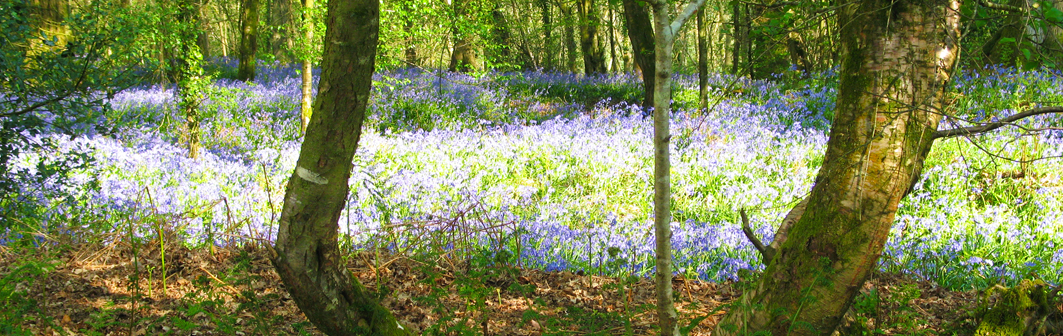
I clearly recall that from an early age I would occasionally drop into a kind of silent reverie when I was alone outside. Tuning into the silence within the sounds of nature around me, I found myself becoming still and, sensing a subtle shift, I could experience a kind of merging that was somehow familiar and reassuring. A mystic’s knowing from a previous life? Or a connection to the oceanic bliss of being in my mother’s womb? Who knows.
I can remember specific occasions when this happened in my childhood, and which left a big impression. But the influence of pragmatic parents and ten years at boarding school ensured that I developed as a logical pragmatist, with the mystic taking a secondary place, less trusted and too sensitive to give shape to my life in a significant way.
My sense is that most people today have a real fear of Silence. I am not going to analyse that further here, but I do feel deeply sad that this is broadly the case. It says so much that we have to fill any and every space with something, with stuff. I admit to having a struggle combating the influence of sophisticated marketing and the bombardment of information and entertainment that have become ’the weapons of mass distraction’, as one of my teachers is quoted as saying. The media machines are trying to put us to sleep with ‘noise’ and are succeeding brilliantly, helping to keep us in denial about the urgent threat to the planet of Climate Change that we ourselves are creating in our hunger for short-term material pleasure.
Yet in reaction to the threat of global collapse, the rise and availability of ways to evolve our consciousness through spiritual (as opposed to religious) practice has been exponential, and it continues to grow. Yoga, in its many forms, has become a major force, often providing a way into meditation through embodied practice for thousands of people, bringing with it dietary and health consciousness, ethical awareness and a sense of our interconnectedness; all of which is a force for good and a cause for hope going forward. I cling to the hope that a widespread rise in spiritual values will engender a growing sense of global responsibility and an appetite for real change before it is too late.
I can’t end this post without including something about by-passing; a dreaded word in spiritual circles. We need to address our emotional baggage just as much as we need to gain spiritual insight. Many teachers tell their students that spiritual practice will also help their emotional woundings and psychological issues. The number of scandals of teachers (often highly evolved ones) abusing their students, is clear evidence that we can become spiritually awake and mature, while remaining emotionally a child, unable to grow up. There is a great danger of lop-sided development as a student of spiritual practice.
Emancipation, to use Bazzano’s term, involves evolving and growing up at all levels, healing psychologically, maturing emotionally, as well as gaining spiritual insight. The term transcendance can imply bypassing, where it avoids the full embodiment of any of these processes. Embodied Evolution would be my definition of the term emancipation in this context, as it ensures that bypassing does not take place.
I have been guilty of it. In fact it has been my primary defence in life to use rationalisation, escaping from my body/feelings into my head to rationalise issues away. A strategy to manage fear as a result of early trauma and the pragmatist’s response to the way of the mystic. The power of the thinking mind over the silent knowing of embodied mystical awareness.
Then there are the levels of denial we use to avoid addressing the grave dangers of our planet in peril; glaring examples of by-passing of course, which is operating throughout western culture, but this is a huge topic to be addressed elsewhere.
Silence is a jewel of great value. I need to keep reminding myself – or rather my pragmatist self – to make time and space for it, to afford it the importance and value it deserves, and I want to remind the world around me, in the face of terrible odds, that we lose this vital resource at our peril, both individually and globally.
Silence gets us under the noise of our thoughts to reach a more subtle spacious consciousness, from where we can begin to touch into the rhythms of nature, the still centre of our own being, compassion for others (human and non-human) and even perhaps to the Ultimate Truth of reality.