When you want to say something, don’t say something which resembles what you want to say but is one step removed. Say exactly what you want to say. Speak the exact words, reach down into your body to find them, into your muscles, lungs, sinews, womb or testicles, fascia, solar plexus and into your gut. Trust that the exact linguistic correlate exists for that feeling, concept, perception, sensation or vision you wish to express. Let your song rise up from through your feet from the dew-soaked earth. Speak the words that wish to come through you, as if by their own volition, and be released and expressed. Speak without shame from your blood sea, from your grief and from your deepest joy. Speak as if you were soon about to die, or as if your words could somehow impossibly deliver the entire world from destruction. Speak with the intonation, the cadence, the melody, the rhythm, the rhyme that reverberates through your body. Let the earth speak through you. Let the gathering storm clouds, the roar of the wind, the shafts of sunlight cascading from the sky, the nectarine ecstatic voice of the beehive speak through you. Let the gesture of an animal or the tremble of the wind through elder tree leaves speak through you. The right words spoken in the right rhythm, at the right time, in the right place have a numinous power, they have the power to affect the body, they have the power to create community. Nature will reply to them. The Gods will hear your words. Matter is malleable in the face of the word; your words have the power to change reality itself.
“When the Sacred Masculine is combined with the sacred feminine inside each of us, we create the ‘sacred marriage’ of compassion and passion in ourselves.” – Matthew Fox
The age of armored masculinity is dead and dying at our feet. It’s a bloody tangle of weaponry and bloated egos glued together by myopic one-upmanship and congealed rage.
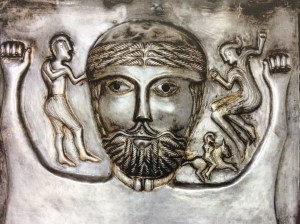
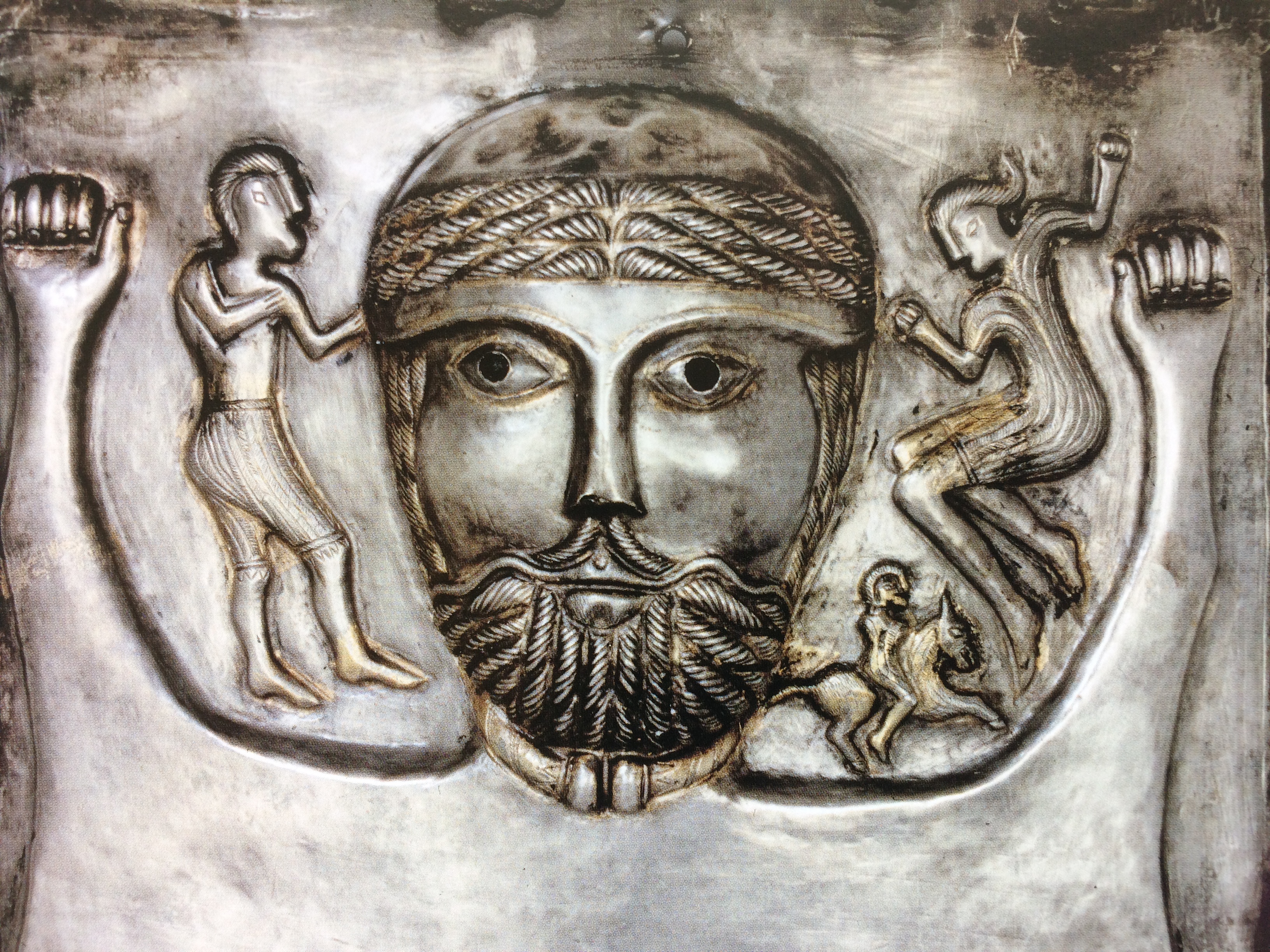
Celtic deity – from the Gundestrup Cauldron, Denmark, 100BC.
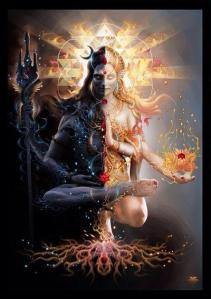
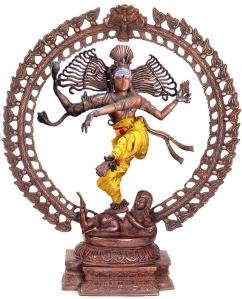
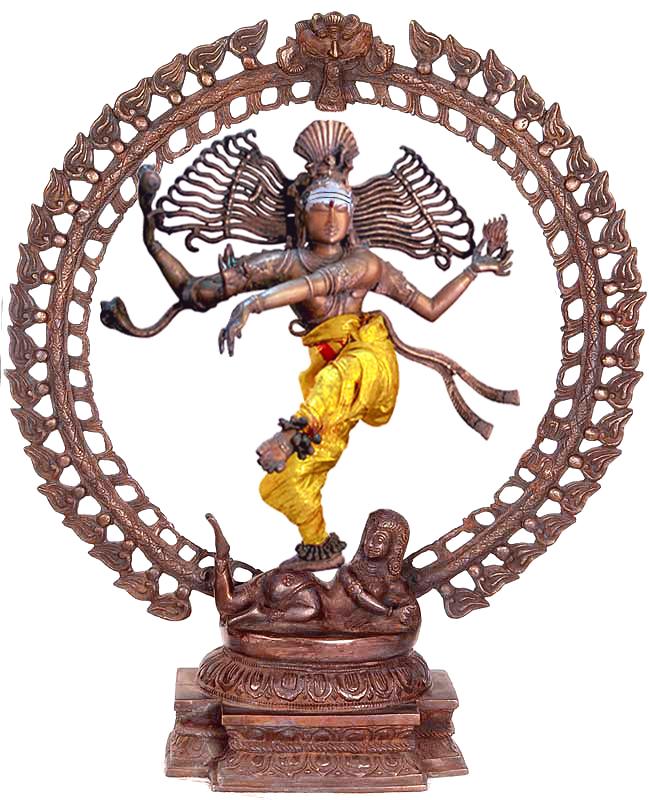
But buried in the rot and decay are the seeds of a new way of being a man in this world, a reawakening of our awareness of the sacred brought on by the reemergence of the divine feminine. No amount of armor can suppress it. No amount of weaponry can keep it at bay. The New Shiva is growing robust and powerful alongside the New Shakti.
The world may not be ready for this New Man to emerge, but emerge he must, if we are to continue living on a planet which is demanding that a healthier more sustainable man appear.
In the same way that both men and women have a feminine aspect, so too do both genders have a masculine aspect. According to analytical psychologist Carl Jung, the feminine aspect of a man is called the anima and the masculine aspect of a woman is called the animus. The New Man, this Shiva incarnate, has the ability to tap into his anima, thereby awakening the divine energy of Shakti from its unconscious state into a state of conscious awareness.
He uses this energy to create rather than destroy, to catalyze rather than militarize, to heal instead of injure. He understands, as Andrea Gibson wrote, “We have to create. It is the only thing louder than destruction.” And so he continually creates ever-changing arenas for further creation.
For thousands of years mankind has been afraid of the light. Even Plato recognized it in his day, saying, “We can easily forgive a child who is afraid of the dark; the real tragedy of life is when men are afraid of the light.” No more.
The redefining of the sacred male principle is the dawn of a new vibrant light, a mature masculinity that is not abusive, domineering or grandiose, but generative, creative, and empowering. He is vulnerable without shame, revealing that his now discarded armor of invulnerability was nothing more than an illusion that hid his true power. He is now free and open to rediscover and reconnect with the power of nature and the cosmos. Tanks be damned. War mongers be damned.
He is ready to establish true relationships with authenticity and integrity. The Great Mystery moves through him, reminding him constantly that he is it and it is him. He is a force of nature first, a man second, the spear of Gaia herself. And no amount of perceived invulnerability can guard against it.
Without the parochial armor of old weighing him down, he frees himself to honor the path of descent, where he engages with the unconscious underworld and is initiated by the Great Mystery itself. Through this initiation he discovers his anima. He discovers his shadow. He discovers a plethora of sub-selves all in contention for his subconscious.
He learns how to make them all conscious. He learns how to wrestle with them, engage with them, play with them, ushering in the beginning of his individuation. After his initiation he takes the first steps toward self-actualization, leaving behind the codependence of his youth and the independence of his courage, and engaging soulfully with the interdependence of his divine masculinity. He has gone from New Man to New God in a mighty feat of self-overcoming that he realizes will require many more feats of the same.
Together with the Sacred feminine, this New God is prepared to engage with the world in a way never before seen. He is Whitman’s multitudes, Goethe’s Faust, Shelly’s Prometheus, Camus’ Sisyphus, and Nietzsche’s Übermensch.
He is Robert Moore’s King, Warrior, Magician, and Lover all wrapped up into one overtly evolving creature. Animal happy, he is Iron John, Wild Man, Father Sky, and Green Man. He is eco-systemic, soul-centric, the prolific planter of the seeds of healthy sustainable change.
He rides alongside the fifth horseman of the apocalypse, protecting her when need be, but mostly empowering her and helping her to see that she is the most powerful thing to ever have existed on the planet.
He is the tip of the spear, self-overcoming and constantly adapting to the constantly changing “air” he flies through. He understands, as Jennifer Ratner-Rosenhagen said, “The real struggle of the heroic individual is not solely to liberate himself from conflict with society, but rather to use the conflict within himself as a source for self-regeneration.”
He is a lover par excellence. But he understands – balls to bones – that love does not imply pacifism. His love is his honor, his honesty, his sincerity in an otherwise dishonorable, dishonest, and insincere world. He has learned how to swallow his pride. He has learned how to forgive.
Indeed, he has learned to forgive all things, not because all things are worthy of forgiveness, but because he is worthy of peace. And through such vulnerable forgiveness his love shines like a mighty beacon of hope for others. He understands that love is a double-edged sword, with which he chooses to stab himself, over and over again, in order to discover the harsh pain of Truth. He accepts that true love is a beautiful annihilation. Like Ken Wilber said, “Real love will take you far beyond yourself; and therefore real love will devastate you.”
Shiva In the end, the sacred masculine exists precisely because of such devastation, rising up from the ashes like his sister the Phoenix. The outdated modes of power that came before him, militaristic and uncouth, are the ashes from which he gathers himself into a force to be reckoned with, a new power that will turn the tables on mankind’s notions of power hitherto.
A power that will co-create a new breed of Hero who has the capacity to expiate his power in order to become a prestigious game changer as opposed to merely a powerful game controller; a truly robust infinite player with the ability to play multiple finite games while respecting the overall infinite game of life.
Militaristic men beware; the time for congratulating yourselves on being conquerors of the world will soon be at an end. Your unsustainable ideals and parochial idols are fast disintegrating all around you. Soon there will be nothing left of your so-called invulnerable constructs of power. It’s time to make way for the healthy New Man, the vulnerable New God, and the truer power of the sacred masculine.
Is it possible to hold all the grief in the world and not get crushed by it?
I ask this question because our failure to deal with the collective and individual pain generated as a result of our destructive economic system is blocking us from reaching out for the solutions that can help us to find another direction.
Our decision to value above all else comfort, convenience and a superficial view of happiness, has led to feelings of disassociation and numbness and as a result we bury our grief deep within our subconscious.
The consequence is not only a compulsion to consume even more in an attempt to hide our guilt but also a projection of our hidden pain onto the world around us and at the deepest level, the Earth itself.
Just take the recent news from WWF and the Zoological Society of London that we have decimated half of all creatures across land, rivers and the seas over the past 40 years.
We read this and perhaps shake our heads in dismay, and then consume the next news story. The question we should all be asking is why aren’t we on the floor doubled up in pain at our capacity for industrial scale genocide of the world’s species.
The same is true of the human blood and tears that have flowed in continents such as Africa over hundreds of years as a result of our system of economic and cultural exploitation.
It’s time to stop searching for reasons why we are failing to act over the imminent dangers of climate change and other sustainability challenges.
The answer is obvious. We don’t need more scientific data or superficial behaviour change initiatives but to engage individuals at a deep emotional, psychological and spiritual level.
As the mythologist Joseph Campbell pointed out: “It is not society that is to guide and save the creative hero, but precisely the reverse. And so every one of us shares the supreme ordeal – carries the cross of the redeemer – not in the bright moments of his tribe’s great victories, but in the silences of his personal despair.” In particular we need to grieve for the destruction we have wrought so that we have a chance to heal ourselves.
I have just experienced this by taking part in a moving grief ceremony conducted by indigenous people from Africa, North America, Latin America and Australia as part of a conference at Findhorn in Scotland, aimed at creating a narrative of how to transition to a new economy based on social and ecological justice.
The point of recalling the rape, pillage and desecration of communities as well as the destruction of ecosystems and biodiversity is not to get stuck in anger and hopelessness, but to transcend them through the power of compassion and forgiveness.
Patricia McCabe from the Dineh Nation of New Mexico and Arizona, who helped lead the ceremony, says the truth and reconciliation commission in South Africa set up in the wake of apartheid, and the justice and reconciliation process in Rwanda after the genocide, serve as proof that expressing grief can lead to a new beginning.
She says: “Humanity has developed a very deep ability to push devastating information about the impacts of our actions into our subconscious and this is a danger. We are numbing ourselves to this life going out.
“Expressing grief has always been a cathartic experience and a rebalancing mechanism, and I believe it is a part of building the foundation for any new story we might want to tell.”
McCabe believes the techniques used for helping people recover from shocks should be used more widely within communities. While indigenous peoples still suffer terribly from the impacts of past exploitation, McCabe says they can help the world because they still hold a deep and close connection to the land and because they understand the power of ceremony to create transformation.
“Many indigenous peoples have a pact with mother Earth that said we would hold on to the principles of thriving life, and that one day the world would turn back and come to us again,” she says. “To be ready for that, we must also go through our grief in order to truly be able to come back into alignment of our mind, body and spirit.”
This article first appeared in The Guardian Sustainable Business section under the name:
‘Grieving could offer a pathway out of a destructive economic system’
Following on from my last post entitled ‘Less Sport, More Support, I found this on the Good Men Project website.
‘One Rule for Boys’ is the title of a new book. Here’s an extract and a link to the full article:
As a psychologist with the Colorado Center for Clinical Excellence, and for 9News KUSA-TV in Denver, Colorado, Dr. Wachtel works hard to provide the best outcomes possible for teens and adults in need of his services. Through his work, however, he has spent time working with thousands of boys and men that have been caught up in the criminal justice system. His focus on assessments and evaluating why they were in the position they were in sparked an awakening in him he wants to share with the world.
A common thread he found in doing his work, or the ‘one rule’ he recently decided to write about is “when boys are taught and encouraged to recognize and express their feelings, and to understand how other people feel―rather than being tough, unemotional, and clueless about the motivations of others―the world becomes a happier, healthier, and safer place.”
Beyond environment: falling back in love with Mother Earth
Zen master Thich Nhat Hanh explains why mindfulness and a spiritual revolution rather than economics is needed to protect nature and limit climate change.
by Jo Confino for the Guardian Professional Network guardian.co.uk, Monday 20 February 2012
Zen master Thich Nhat Hanh says a spiritual revolution is needed if we are going to confront the environmental challenges that face us.
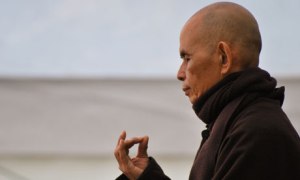
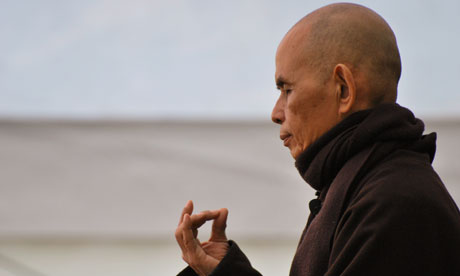
Zen master Thich Nhat Hanh has been practising meditation and mindfulness for 70 years and radiates an extraordinary sense of calm and peace. This is a man who on a fundamental level walks his talk, and whom Buddhists revere as a Bodhisattva; seeking the highest level of being in order to help others.
Ever since being caught up in the horrors of the Vietnam war, the 86-year-old monk has committed his life to reconciling conflict and in 1967 Martin Luther King nominated him for the Nobel Peace Prize, saying “his ideas for peace, if applied, would build a monument to ecumenism, to world brotherhood, to humanity.”
So it seems only natural that in recent years he has turned his attention towards not only addressing peoples’ disharmonious relationships with each other, but also with the planet on which all our lives depend.
Thay, as he is known to his many thousands of followers, sees the lack of meaning and connection in peoples’ lives as being the cause of our addiction to consumerism and that it is vital we recognise and respond to the stress we are putting on Earth if civilisation is to survive.
What Buddhism offers, he says, is the recognition that we all suffer and the way to overcome that pain is to directly confront it, rather than seeking to hide or bypass it through our obsession with shopping, entertainment, work or the beautification of our bodies. The craving for fame, wealth, power and sex serves to create only the illusion of happiness and ends up exacerbating feelings of disconnection and emptiness.
Thay refers to a billionaire chief executive of one of America’s largest companies, who came to one of his meditation courses and talked of his suffering, worries and doubts, of thinking everyone was coming to take advantage of him and that he had no friends.
In an interview at his home and retreat centre in Plum Village, near Bordeaux, Thay outlines how a spiritual revolution is needed if we are going to confront the multitude of environmental challenges.
While many experts point to the enormous complexity and difficulty in addressing issues ranging from the destruction of ecosystems to the loss of millions of species, Thay sees a Gordian Knot that needs slicing through with a single strike of a sharp blade.
Move beyond concept of the “environment”
He believes we need to move beyond talking about the environment, as this leads people to experience themselves and Earth as two separate entities and to see the planet in terms only of what it can do for them. Change is possible only if there is a recognition that people and planet are ultimately one and the same.
“You carry Mother Earth within you,” says Thay. “She is not outside of you. Mother Earth is not just your environment.
“In that insight of inter-being, it is possible to have real communication with the Earth, which is the highest form of prayer. In that kind of relationship you have enough love, strength and awakening in order to change your life.
“Changing is not just changing the things outside of us. First of all we need the right view that transcends all notions including of being and non-being, creator and creature, mind and spirit. That kind of insight is crucial for transformation and healing.
“Fear, separation, hate and anger come from the wrong view that you and the earth are two separate entities, the Earth is only the environment. You are in the centre and you want to do something for the Earth in order for you to survive. That is a dualistic way of seeing.
“So to breathe in and be aware of your body and look deeply into it and realise you are the Earth and your consciousness is also the consciousness of the earth. Not to cut the tree not to pollute the water, that is not enough.” Putting an economic value on nature is not enough
Thay says the current vogue in economic and business circles that the best way to protect the planet is by putting an economic value on nature is akin to putting a plaster on a gaping wound.
“I don’t think it will work,” he says. “We need a real awakening, enlightenment, to change our way of thinking and seeing things.”
Rather than placing a price tag of our forests and coral reefs, Thay says change will happen on a fundamental level only if we fall back in love with the planet: “The Earth cannot be described either by the notion of matter or mind, which are just ideas, two faces of the same reality. That pine tree is not just matter as it possesses a sense of knowing. A dust particle is not just matter since each of its atoms has intelligence and is a living reality.
“When we recognise the virtues, the talent, the beauty of Mother Earth, something is born in us, some kind of connection, love is born.
“We want to be connected. That is the meaning of love, to be at one. When you love someone you want to say I need you, I take refuge in you. You do anything for the benefit of the Earth and the Earth will do anything for your wellbeing.”
In the world of business, Thay gives the example of Yvon Chouinard, founder and owner of outdoor clothing company Patagonia, who combined developing a successful business with the practice of mindfulness and compassion: “It’s possible to make money in a way that is not destructive, that promotes more social justice and more understanding and lessens the suffering that exists all around us,” says Thay.
“Looking deeply, we see that it’s possible to work in the corporate world in a way that brings a lot of happiness both to other people and to us … our work has meaning.”
Thay, who has written more than 100 books, suggests that the lost connection with Earth’s natural rhythm is behind many modern sicknesses and that, in a similar way to our psychological pattern of blaming our mother and father for our unhappiness, there is an even more hidden unconscious dynamic of blaming Mother Earth.
In a new essay, Intimate Conversation with Mother Earth, he writes: “Some of us resent you for giving birth to them, causing them to endure suffering, because they are not yet able to understand and appreciate you.” How mindfulness can reconnect people to Mother Earth
He points to increasing evidence that mindfulness can help people to reconnect by slowing down and appreciating all the gifts that the earth can offer.
“Many people suffer deeply and they do not know they suffer,” he says. “They try to cover up the suffering by being busy. Many people get sick today because they get alienated from Mother Earth.
“The practice of mindfulness helps us to touch Mother Earth inside of the body and this practice can help heal people. So the healing of the people should go together with the healing of the Earth and this is the insight and it is possible for anyone to practice.
“This kind of enlightenment is very crucial to a collective awakening. In Buddhism we talk of meditation as an act of awakening, to be awake to the fact that the earth is in danger and living species are in danger.”
Thay gives the example of something as simple and ordinary as drinking a cup of tea. This can help transform a person’s life if he or she were truly to devote their attention to it.
“When I am mindful, I enjoy more my tea,” says Thay as he pours himself a cup and slowly savours the first sip. “I am fully present in the here and now, not carried away by my sorrow, my fear, my projects, the past and the future. I am here available to life.
“When I drink tea this is a wonderful moment. You do not need a lot of power or fame or money to be happy. Mindfulness can help you to be happy in the here and now. Every moment can be a happy moment. Set an example and help people to do the same. Take a few minutes in order to experiment to see the truth.” Need to deal with ones own anger to be an effective social activist
Thay has over many years developed the notion of applied Buddhismunderpinned by a set of ethical practices known as the five mindfulness trainings, which are very clear on the importance of tackling social injustice.
However, if social and environmental activists are to be effective, Thay says they must first deal with their own anger. Only if people discover compassion for themselves will they be able to confront those they hold accountable for polluting our seas and cutting down our forests.
“In Buddhism we speak of collective action,” he says. “Sometimes something wrong is going on in the world and we think it is the other people who are doing it and we are not doing it.
“But you are part of the wrongdoing by the way you live your life. If you are able to understand that, not only you suffer but the other person suffers, that is also an insight.
“When you see the other person suffer you will not want to punish or blame but help that person to suffer less. If you are burdened with anger, fear, ignorance and you suffer too much, you cannot help another person. If you suffer less you are lighter more smiling, pleasant to be with, and in a position to help the person.
“Activists have to have a spiritual practice in order to help them to suffer less, to nourish the happiness and to handle the suffering so they will be effective in helping the world. With anger and frustration you cannot do much.” Touching the “ultimate dimension”
Key to Thay’s teaching is the importance of understanding that while we need to live and operate in a dualistic world, it is also vital to understand that our peace and happiness lie in the recognition of the ultimate dimension: “If we are able to touch deeply the historical dimension – through a leaf, a flower, a pebble, a beam of light, a mountain, a river, a bird, or our own body – we touch at the same time the ultimate dimension. The ultimate dimension cannot be described as personal or impersonal, material or spiritual, object or subject of cognition – we say only that it is always shining, and shining on itself.
“Touching the ultimate dimension, we feel happy and comfortable, like the birds enjoying the blue sky, or the deer enjoying the green fields. We know that we do not have to look for the ultimate outside of ourselves – it is available within us, in this very moment.”
While Thay believes there is a way of creating a more harmonious relationship between humanity and the planet, he also recognises that there is a very real risk that we will continue on our destructive path and that civilisation may collapse.
He says all we need to do is see how nature has responded to other species that have got out of control: “When the need to survive is replaced with greed and pride, there is violence, which always brings about unnecessary devastation.
“We have learned the lesson that when we perpetrate violence towards our own and other species, we are violent towards ourselves; and when we know how to protect all beings, we are protecting ourselves.” Remaining optimistic despite risk of impending catastrophe
In Greek mythology, when Pandora opened the gift of a box, all the evils were released into the world. The one remaining item was “hope”.
Thay is clear that maintaining optimism is essential if we are to find a way of avoiding devastating climate change and the enormous social upheavals that will result.
However, he is not naïve and recognises that powerful forces are steadily pushing us further towards the edge of the precipice.
In his best-selling book on the environment, The World we Have, he writes: “We have constructed a system we can’t control. It imposes itself on us, and we become its slaves and victims.
“We have created a society in which the rich become richer and the poor become poorer, and in which we are so caught up in our own immediate problems that we cannot afford to be aware of what is going on with the rest of the human family or our planet Earth.
“In my mind I see a group of chickens in a cage disputing over a few seeds of grain, unaware that in a few hours they will all be killed.”
From an Ebook entitled ESCAPE TO THE HOMELANDS OF THE HEART
written by Michael R. Dale
… Now what of the poet archetype? Where does the Inner Poet fit in?
The poet archetype is so important, because it is in a poetic frame of mind and spirit. Through it, we are able to interpret all the other archetypes most effectively. Remember archetypes are the soul’s way of communicating the unconscious and poetry is the language of the soul.
The energy of the poet archetype is one of metaphor, interpretation, connection and translation. Just as when meditating we cultivate the witness – a detached, watchful eye that spectates without judgment on the ephemeral nature of existence – the poet is the observer and the interpreter of the internal world – the feminine kingdom of the soul.
Just as skill acquisition is a meta-skill, the poet archetype is a meta-archetype – the observer and interpreter of all the other archetypes within us. The Inner Poet is the alchemist to whom the soul alone will bear its deepest secrets – the trusted emissary of her otherwise indecipherable love letters to the king, who reigns over the conscious ego mind.
For further testimony to this assertion I must again turn to Robert A Johnson and his words on the alchemists of old, “Alchemy – that treasure house of psychological insight that is so often mistaken for early attempts at chemistry – traces out the steps of synthesis in poetic language.”
Inner-work is the work of connecting with observing and interpreting the wonderful and terrifying world of within – the work of creating new meaning, awareness and healing where pain and confusion and suffering presided previously. The work of lovingly embracing every facet of our being – is alchemy – and alchemy is inner-work. The metaphor of turning lead into gold is exactly that, a metaphor.
Alchemy is turning problems into opportunities, turning pain into wisdom, turning hatred into compassion. Poetry is alchemy, when you take for instance burning rage, death, uncontrollable desire or even something mundane like boredom and put that into words on a page, you create something raw, intense and alive, something beautiful; a window into your heart that leads you to a deeper understanding of who you really are. You create an avenue for your ego and your soul to approach each other as equals and unite in the homelands of your heart.
This chapter ends with a poem called: Every poet is an alchemist
The polarities are changing with respect to gender. Soon it won’t be men vs. women. It will be the awakening vs. the asleep, the heartfelt vs. the heartless.
Men will rise up and stand beside women in opposition to those men who imprison all of us. The kind of men who ordered the gang rape in India, the kind of men who manipulate economic systems solely for their own benefit, will be met with a gender inclusive force of benevolent souls, who will no longer tolerate the raping of this planet or the women who mother it.
I appreciate the good intentions of those who believe that we are ready to move away from opposition as a construct altogether, but I feel they are putting the heart before the force. It’s premature. We still need to fight for our right to the light, and we need to do it together. Not as two polarized genders, but as souldiers of a higher order united by love.
From Jeff Brown’s SOULSHAPING facebook group 22nd July 2014
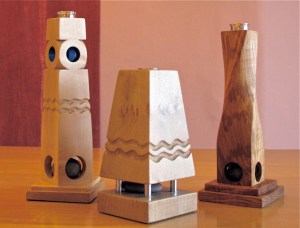
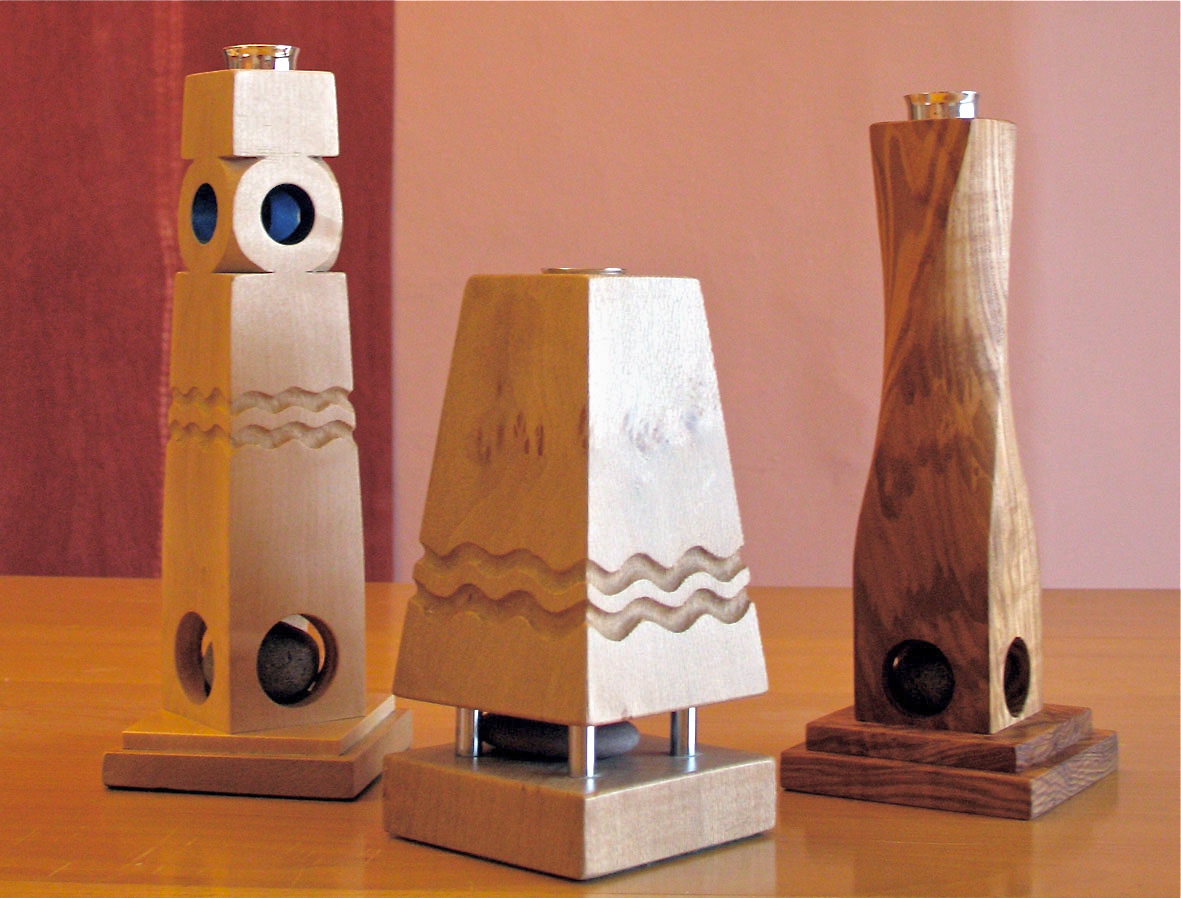
Handmade candlesticks by Paul SwatridgeIn 2011 the Crafts Council marked the Year of Craft. Novelist JEANETTE WINTERSON was invited to write about our special relationship with hand-made objects. I agree with so much of what she wrote and take pleasure in posting it on my blog: Olive Wood Heart made as a wedding present by Paul Swatridge
THE MOST SATISFYING thing a human being can do – and the sexiest – is to make something. Life is about relationships – to each other – and to the material world. Making something is a relationship.
The verb is the clue. We make love, we make babies, we make dinner, we make sense, we make a difference, we make it up, we make it new . . . True, we sometimes make a mess but creativity never was a factory finish.
The wrestle with material isn’t about subduing; it is about making a third thing that didn’t exist before. The raw material was there, and you were there, but the relationship that happens between maker and material allows the finished piece to be what it is. And that allows a further relationship to develop between the piece and the viewer or the buyer.
Both relationships are in every way different from mass production or store-bought objects that, however useful, are dead on arrival. Anyone who makes something finds its life, whether it’s Michelangelo releasing David from 20 tons of Carrara marble, or potter Jane Cox spinning me a plate using the power of her shoulders, the sureness of her hands, the concentration of her mind.
I have a set of silverware made by an 18th century silverworker called Hester Bateman, one of the very few women working in flatware at that time. When I eat with her spoons, I feel the work and the satisfaction that went into making them – the handle and bowl are in equal balance – and I feel a part of time as it really is, not chopped into little bits, but continuous. She made this beautiful thing, it’s still here, and I am here too, writing my books, eating my soup, two women making things across time.
I feel connection, respect, delight. And it is just a spoon . . . But the thing about craft, about the making of everyday objects that we can have around us, about the making of objects that are beautiful and/or useful, is that our everyday life is enriched.
How is it enriched? To make something is to be both conscious and concentrated – it is a fully alert state, but not one of anxious hyper-arousal. We all know the flow we feel when we are absorbed in what we do.
I find that by having a few things around me that have been made by someone’s hand and eye and imagination working together, I am prevented from passing through my daily life in a kind of blur.
I have to notice what is in front of me – the table, the vase, the hand-blocked curtains, the thumb prints in the sculpture, the lettering block. I have some lamps made by Marianna Kennedy, and what I switch on is not a bulb on a stem; it is her sense of light. So I am in relationship to the object and in relationship to the maker. This allows me to escape from the anonymity and clutter of the way we live now. Instead of surrounding myself with lots of things I hardly notice, I have a few things that also seem to notice me. No doubt this is a fantasy, but . . . The life of objects is a strange one.
A maker creates something like a fossil record. She or he is imprinted in the piece. We know that energy is never lost, only that it changes its form, and it seems to me that the maker shape-shifts her/himself into the object. That is why it remains a living thing.
Of course it is possible to design an object that will be made by others, but that is an extension of the creative relationship, not its antithesis. It is the ceaseless reproduction of meaningless objects that kills creativity for all of us, as producers and consumers. But are producers and consumers who we want to be?
To make is to do. It is an active verb. Creativity is present in every child ever born. Kids love making things.
There are different doses and dilutions of creativity, and the force is much stronger in some than in others – but it is there for all of us, and should never have been separated off from life into art.
I would like to live in a creative continuum that runs from the child’s drawing on the fridge to Lucien Freud, from the coffee cups made by a young ceramicist to Grayson Perry’s pots.
We don’t need to agonise over the boundaries between “art” and “craft”, any more than we should be separating art and life. The boundary is between the creative exuberance of being human, and the monotony of an existence dependent on mass production – objects, food, values, aspirations.
Making is personal. Making is shared.
Making is a celebration of who we are.
Maya giving birth to the Buddha, holding the branch of a tree.
The pre-patriarchal, “matricentric” period of Old Europe flourished from around 6500 B.C. until the Aryan invasions around 3500 BC. For the last 5500 years, patriarchy – an archetypal pattern of oppressive male governance – has been an integral characteristic of Western civilization. What does it mean, not simply for the personal fulfilment of women, but for the destiny of the Earth and the viability of the human species?
Patriarchy, western history & the destiny of the Earth When the apparent success of the earlier matricentric period is compared with the devastation of the Earth resulting from the civilizational order that followed, we have a comprehensive critique of the Western civilizational process that has probably never been surpassed. We are confronted with a profound reversal of values. The entire course of Western civilization is seen as vitiated by patriarchy – the aggressive, plundering, male domination of our society.
If we inquire into the driving forces that have evoked this critical re-evaluation of Western civilization, we can identify them as the rising consciousness of women and the devastation of all the basic living forms of the Earth presently taking place in consequence of the male-dominated regimes that have existed during this period. The new mode of ecological consciousness now emerging sees the new period of the Earth community as having a basic nurturing aspect that tends more toward traditional feminine than toward masculine qualities. There are indeed religious, cosmological, biological, and historical reasons for considering the feminine as having a special role in our thinking about the Earth.
Our most prominent illustration of male rule over the extended tribal family is found in the patriarchal period in earliest biblical narratives, prior to establishment of separate roles for priest and prophet. Even more important is the patria potestas in Roman law. In this period the father had absolute rights over his entire family, including the right to impose capital punishment. The extended family was a total possession. The father owned everything and decided everything….When joined with the heroic leadership ideals of [later] barbarian peoples, the tradition of rule by male warrior personalities was well established in the European world.
Ecclesiastically, patriarchy designates the supreme centres of prestige in the [Christian] church. The four great patriarchies of the Eastern Christian church are Constantinople, Jersusalem, Alexandria, and Antioch. In the West the supreme patriarchate is centered in Rome. Since religious authority in the West has always been exercised by a male priesthood and required immediate and total acceptance by the believing community, this, too, contributed mightily to the sense of patriarchal responsibility for the unfolding of Western history.
From these beginnings the term patriarchy has now been brought forward as a way of indicating the larger sources of responsibility for what is happening not only with women, but also with the total civilizational structure of our society and even with the planet itself. The sense of patriarchy has now evolved as the archetypal pattern of oppressive governance by men with little regard for the well-being or personal fulfilment of women, for the more significant human values, or for the destiny of the Earth itself.
The Venus of Brassempouy, a fragmentary ivory figurine from the Upper Palaeolithic, 25,000 years old, it is one of the earliest realistic representations of the female face.
The basic pathology of western civilization
Choice of the term patriarchy for defining the basic pathology of Western civilization is being confirmed by historical evidence of an earlier, more benign civilizational period, a matricentric, matrifocal or matriarchal period. Judy Chicago concludes that ”all archaeological evidence indicates that these matriarchal cultures were egalitarian, democratic, peaceful. But female-oriented agricultural societies gradually gave way to a male-dominated political state in which occupational specialization, commerce, social stratification, and militarism developed.”
Change from this earlier period to a dominant patriarchal type of civilizational process took place in Old Europe, apparently with the invading Aryan Indo-European peoples, beginning around 4500 BC, the period from which we trace the most profound determinations of our Western mode of consciousness. In the words of Marija Gimbutas, “The earliest European civilization was savagely destroyed by the patriarchal element, and it never recovered, but its legacy lingered in the substratum which nourished further European cultural development.” Those proposing this reversal of values are not arguing exactly from philosophical principles, but from historical realities and from our planetary peril, as well as from the deepest realms of the human psyche.
The human is nonviable in its present mode of patriarchy The historical mission of the present is to introduce a more integral period of Earth development, a period when a mutually enhancing human-earth relationship might be established—if indeed the human is to prove itself to be a viable species on a viable planet. That the human is nonviable in its present mode of partriarchal functioning seems to be quite clear.
Even in this period of patriarchal dominance the heritage of the earlier matricentric phase has continued as an undercurrent within Western cultural traditions. Matricentric ways of thinking and their associated rituals seem to be among the compoment elements of our submerged cultural traditions. They carry on an earlier wisdom associated with alchemy, astrology, the pagan nature rituals, and the hermetic teachings. These hidden traditions, considered destructive and unacceptable within the religious-humanist traditions of Western society, need reconsideration for the contributions they make to our understanding of the universe, its deeper modes of functioning, and the proper role of the human. They carry some of the most creative aspects of our civilization. In their symbolic modes of expression, especially, they enable us to go beyond the rational processes derivative from the classical philosophers and our later theologies. Through these traditions we have recovered our understanding of the archetypal world of the unconscious.
As we look back on the Western historical process, we can identify four patriarchal establishments that have been in control of Western history over the centuries. However benign our view of these establishments or however brilliant in some of their achievements, we must observe that they have become progressively virulent in their destructive powers, until presently they are bringing about the closing down of all the basic life systems of the planet.
These four establishments are: the classical empires, the ecclesiastical establishment, the nation-state, and the modern corporation. The four are exclusively male-dominated and primarily for fulfilment in terms of the human as envisaged by men. Women had minimal if any consistent role in the direction of these establishments.
G. Boulanger: The Slave Market
First patriarchal establishment: classical empires These empires had their precedent in the sacred rulers that appeared in Sumeria and in Egypt some 5000 years ago. They were identified by Karl Wittfogel as “the harshest expression of total power”. When we look at the grandeur of these civilizations and at their successors in Assyria and Babylonia, we can only wonder at so much oppression coexisting with such stupendous achievements….In terms of fully organized political rule over a diverse association of peoples, the earliest of the empires was the Persian empire under Cyrus in the sixth century BC. Then came the Macedonian empire of Alexander and the Roman Empire in the Western world. In the East came the sequence of Chinese empires…In India the imperial process produced Asoka in the third century BC, one of the most benign of the great rulers of the period.
This sequence of empires was succeeded in the West by the Byzantine empire, the Holy Roman empire in Europe, then the later empires with a dominant presence of the Spanish, the Portuguese, the Dutch, the French and the British – all overseas – while the Russians expanded their empire throughout the Eurasian continent.
The triumphal achievements of imperial personalities were extolled in epic poetry such as the Homeric accounts of the Iliad and the Odyssey and the Aeniad of Virgil…These epic stories became the inspiration of succeeding generations.To doubt these ideals or to fail in enthusiasm for these wars, whether of defence or conquest, would be to doubt not only the human process, but also the divine disposition of the universe.
Second patriarchal establishment: ecclesiatical christianity
In the sacred writings of the Bible we find a warring deity and warrior ideals. If a more peaceful teaching did arise in the gospels, it did not survive the challenge that arose in later centuries when conflict appeared as the way for survival. In the age of chivalry, efforts were made to mitigate the violence by a sense of dedicated strength in the service of the weak who were assaulted by the strong. Once the natural and human worlds were envisaged as inherently subject to the strife for power, the way of peace and pacifism was no longer available. As with any addiction, it could only become worse. The pathology was too deep and too universal to eradicate at the time. It could only continue until the bombs were dropped on Hiroshima and Nagasaki and industrial nations began construction of nuclear warheads sufficient to extinguish all the greater life forms on the planet.
The church was the single comprehensive, trans-national authority in the Western world for more than a thousand years. …The main determinant of reality and value in Western civilization was expressed in the belief structures it presented….Here is the deepest source and support for the patriarchal tradition of Western civilization. It is also the most profound challenge in terms of the reversal taking place in our understanding of reality and value. The sense of the sacred in any civilization is precisely that which cannot be questioned, for the sense of the sacred is the unquestionable answer to all questions.
The biblical tradition begins with the creation narrative wherein the Earth Mother of the eastern Mediterranean is abandoned in favour of the transcendent Heaven Father. Later the relationship between the human and the divine is constituted in terms of a covenant between a chosen people and a personal transcendent creative Father deity. This becomes the context in which human-divine affairs are worked out over the succeeding centuries. The natural world is no longer the locus of the meeting of the divine and the human. A subtle aversion develops toward the natural world, a feeling that humans in the depth of their beings do not really belong to the earthly community of life, but to a heavenly community. We are presently in a state of exile from our true country.
In the Bible narrative, woman becomes the instrument for the entry of evil into the world and for the breakdown in human-divine relations. Only in a derivative sense, through their association with men, do women function in the public life of the sacred community. Later, in explanation of the lesser quality of female being, women are seen as biologically the consequence of some lack of vigour in the male component of the conception process, since in its full energy conception should produce a male child. In this context the whole of feminine existence becomes profoundly diminished as a mode of personal being.
Third patriarchal establishment: the nation state
The next patriarchal establishment that needs consideration is the nation-state…The nation-state might be considered the most powerful institution ever invented for organizing human societies. Above all, the concept of national sovereignty came into being. This concept might be considered a supreme expression of what we are here designating as patriarchy, the aggressive use of power in pursuit of the male values of conquest and dominion… The various Western people have consistently gone to war over the past few centuries in defence of national honour and in a vain effort at national security. This has led in turn to citizen armies, to universal conscription for military purposes. Such armies in modern times are an invention of the nation-state…
Beyond the concept of total war is also the concept of world war. These wars have become so endemic, the instruments of warfare so destructive, and the financial cost of military activities so exhausting that we must wonder how long these conflicts and the threat of such conflicts can endure. They are driven obviously by the deepest of our civilizational pathologies, originating, as so many pathologies, in some distorted sense of the sacred.
As with the ancient empires and the ecclesiastical establishment, so now with the nation-state; it was an affair carried out by men and for the ideals of men. Women were without power in the public realm, in its values, or in its functioning. Women functioned in areas withdrawn from the public life of the society: in the home, caring for children, serving men…Women did not participate in the electoral process in the United States until 1920, and in Great Britain until 1928. Even as late as 1987, there were only 2 women in the 100-member U.S. Senate, 24 in the 411-member House of Representatives. The first woman member of the Supreme Court was appointed in 1981. This type of imbalance was no longer acceptable to women, who comprise more than half the population. They were no longer willing to accept such control over their lives or over the public life of the society or over the integral functioning of the Earth. The feminist movement became a pervasive influence through society.
The corporation sells itself as eroticized mother (1970).
Fourth patriarchal establishment: the business corporation
Whether industrial, financial, or commercial, the corporation is considered the primary instrument of “progress,” although just what progress means is never clear. The supposition seems to be that the greater the devastation of the natural world through construction of highways, airports, development projects, shopping malls, supermarkets, and corporate headquarters, the closer we are to fulfilling the American Dream. It is precisely through this dream vision of a new humanly-created wonderworld that the advertising industry brings about that level of heightened consumption upon which the corporation depends for its ever-increasing control over our society and its ever-increasing profits. Through advertising the corporation has gained control over the public media. Through the public media the corporation controls the deepest psychic as well as the most powerful physical forces of the planet.
Because the industrial-commercial corporation is so central to contemporary existence, our educational programs have become subservient to its control. High school and college students must prepare themselves for jobs within this industrial-commercial setting. This industrial context of American life can be thought of as an all-enclosing bubble. Outside the bubble there is neither life nor joy nor any decent manner of human fulfilment. Within the bubble we can live and work and earn money and enjoy the ever-fascinating programs flowing across the television screen. In support of this process, our scientific research institutes—those in the universities and technical schools and those within industrial establishments—are constantly at work inventing a multitude of products that range from vast instruments of nuclear warfare to the frivolous products that have no purpose other than making a profit for some enterprising entrepreneur.
Since the 1880s this has been the age of the engineers, people of inventive genius joining scientific knowledge with technological skills, especially in the electronic and petrochemical industries. With this knowledge and these skills our engineers can build the great hydroelectric dams that destroy our rivers; drown our soil in chemical fertilizers, pesticides, and herbicides; throw satellites into space until the debris begins to clutter the heavens; and invent a million varieties of plastic objects that are scattered over both the land and the sea. They can do all that, but they seem to have not the slightest idea of how to establish a mutually enhancing mode of human presence upon the Earth. They only make the human a deadly and intolerable presence on the planet.
The difficulty with our industrial wonderworld is that its products last for a brief period and then forever remain as a trashed and toxic world in which we and all future generations are condemned to live for an indefinite period. Like the illusion of a magician, we are presented with the blissful moment in the use of these inventions, with no indication of their abiding dark aspect. Human productions do not consistently renew themselves in the manner of natural forms.
The Styrofoam cup used momentarily in some fast-food establishment must either remain forever in some ever-mounting trash deposit or else release its toxic components into the environment when it is destroyed. So with hospital equipment, so with plastic diapers. To label such products as “disposable” is to falsify the reality. In the natural world there is no such problem as that of disposing of some product. The waste product from one life-form is the nourishment of another. We, on the other hand, are making a world of universal waste and maximal entropy.
As noted by Elizabeth Dodson Gray, this inability to deal with waste matter is a typical failure of the male in our society. Cleanup tasks have consistently been left for the women. As men have seldom shared in the cleanup tasks associated with their biological children, so they reveal their incompetence and lack of concern over the cleanup tasks associated with their industrial children. In this case, however, the consequences are a geological, biological, and ultimately, human disaster.
This is power. The power of men. The power to profoundly disturb the most significant functioning of the Earth. Women have had minimal presence, except as needed for service positions. In this regard, over the generations women have consistently been exploited by the various business processes. In the early days of the textile industry, women were employed as cheap labour that developed into the sweatshop system in the large cities of the East. In various business ventures women did the secretarial work. They were file clerks, typists, waitresses, cleanup persons. More professional roles were found in nursing, social work, teaching, writing. Some women had brilliant careers in the performance arts: in music and song and dance and drama.
Yet these have not been the positions of power that are needed to alter the larger directions taken by our society. Those positions are still held by men, and for their own purposes. If mitigations have appeared, they have served only to make industrial processes more endurable…the tendency to constantly modify an existing system without changing the basic pattern of its functioning. What is needed is a profound alteration of the pattern itself, not some modification of the pattern. To achieve this, the basic principle of every significant revolution needs to be asserted: rejection of partial solutions….The pain to be endured from the change must be experienced as a lesser pain to that of continuing the present course.
A pathology beyond adequate description or comprehension
The four patriarchal establishments have made a world that carries within it a certain pathos. Assuredly there is grandeur in many of its achievements. Enormous energies have been expended in what has been thought to be beneficial to the larger human process. To realize suddenly that so much of this has been misdirected, alienating, and destructive beyond anything previously known in human history is a bitter moment indeed….Only in the late twentieth century, have the awesome dimensions of our cultural and institutional pathologies become clarified.
None of the other revolutionary movements in Western civilization has prepared us for what we must now confront. Quite naturally this demand for change, as with all such moments of radical confrontation, brings with it a heightened level of psychic intensity. Everything is at stake. This is something more than feminine resentment at personal neglect or oppression. It is possibly the most complete reversal of values that has taken place since the Neolithic period.
The ethical basis of our judgment concerning good and evil is itself being identified as anti-feminist, anti-human, anti-Earth. Our legal system is seen as supportive of a patriarchal bias against the feminine dimension of the human and therefore as offensive to the human itself. The legal system is especially deficient in its radical inability to deal with questions of human-Earth relationships. The medical profession has made some shocking mistakes in its inability to deal with the simplest aspects of the well-being of women and of children in their infant stage. Also it is revealing its inability to function effectively as a profession in the public arena in relation to the continuing toxification of the entire biosphere. When the breast milk of women becomes questionable nourishment for infants because of its contamination with toxins, something more in the form of public protest might be expected from the medical profession, as well as from the legal profession and the professional moralists.
The greatest support for the feminist, anti-patriarchal movement can be found in the ecological movement. As regards the ecological integrity of the Earth, the four establishments that we have mentioned all come under condemnation as leading to a non-viable mode of the human and even to a non-viable mode of the Earth in its major life systems. As Norman Myers has indicated, we are bringing about an “extinction spasm” that is likely to produce “the greatest setback to the abundance and variety of life since the first flickering of life on Earth some four billion years ago.” That we should presently be killing off the rain forests at the rate of some fifty acres per minute is an irreversible tragedy. When we consider especially that these rain forests contain fully half the living species of life upon the Earth and that they took some sixty-five million years to attain their present status, this is obviously a pathology beyond adequate description or comprehension.
The situation is further aggravated when we consider that none of the institutions that we have identified as the four basic patriarchal establishments has seriously protested the situation nor made serious efforts to stop its involvement in the process. They are indeed still fostering the industrial plundering of the planet as part of the progress myth from which the devastation took its beginning. What has become progressively clear is the association of the feminine issue with the ecological issue.
One of the main characteristics of the emerging ecological period is the move from a human-centred norm of reality and value to a nature-centred norm. We cannot expect life, the Earth, or the universe to fit into our rational human designs of how life, the Earth, or the universe should function. We must fit our thinking and our actions within the larger process. We must move from democracy to biocracy. We need a United Species, not a United Nations.
We came into being within the life community through the billions of years that it took to shape a world into which humans could be born. It has been a creative maternal process throughout, with all the violence of the primordial fireball, the supernova explosions, and the volcanic eruptions from within the Earth itself. However terrifying these transition moments, they have consistently been birth moments. We might hope that what we are now experiencing is another birth moment, yet the patriarchal period is too poignant in its past memories and its present realities for us to fully understand what is happening or what will emerge in the years to come. Too much of what we are doing is irreversible. What we can say is that the Earth seems to be rising in defence of herself and her children after this long period of patriarchal dominion.
The above is an edited synopsis of Patriarchy: A New Interpretation of History, from The Dream of the Earth.
I found this article at: http://www.ecobuddhism.org/solutions/wde/bp There are many interesting articles on this website.